
A Model Context Protocol (MCP) server for Fish Audio TTS (Text-to-Speech) via the AceDataCloud platform. Generate natural-sounding speech and explore the Fish voice model library.
- High-quality TTS: Generate speech from text via Fish Audio models
- Voice library: Browse, search, and fetch metadata for Fish voice models
- Asynchronous tasks: Submit generation tasks and poll for results
- Batch task lookup: Query multiple task results in one call
Pass one public HTTPS reference audio URL plus its exact transcript. This conditions only the current TTS request and does not create a reusable voice model:
fish_generate_audio(
    text="New speech in the referenced voice",
    reference_audio_url="https://cdn.acedata.cloud/reference.mp3",
    reference_text="The exact words spoken in the reference audio",
)
Use reference_id for saved or public voices, and the one-shot reference fields for a temporary voice. Do not combine them. Reference audio supports MP3/WAV and should be 10–270 seconds. Billing remains based on the target text's UTF-8 byte count.
The hosted endpoint is https://fish.mcp.acedata.cloud/mcp. Choose one route for the MCP client:
| Route | When to use it | Credential setup |
|---|---|---|
| Hosted OAuth | The client supports remote MCP OAuth | Add only the URL, then sign in to AceDataCloud and approve access. No token needs to be pasted into client configuration. |
| Hosted API token | The client cannot finish OAuth, or you need an explicit integration credential | Send an AceDataCloud API token in the Authorization: Bearer … header. Keep it in a local secret store or environment variable. |
| Local stdio | The client runs a local MCP process | Install mcp-fish and pass ACEDATACLOUD_API_TOKEN to that process. It still calls the AceDataCloud API. |
The hosted service advertises OAuth metadata and Dynamic Client Registration (DCR). DCR registers the client application; it is not an API key. OAuth signs you in and the client sends the resulting Bearer token; it may reuse or create an API credential for the account. Browser sign-in still requires an AceDataCloud account. The hosted service can be metered: review current service documentation and displayed pricing before a real operation. Do not configure both an OAuth login and a fixed Authorization header for the same server.
- Claude and Claude Desktop chat: Add a remote custom connector in
Customize → Connectors → Add custom connector, enterhttps://fish.mcp.acedata.cloud/mcp, select sign-in, and choose Register automatically if Claude asks how to register its OAuth client. Complete consent. Claude Desktop's localclaude_desktop_config.jsonis a separate setup. Claude connector guide. - Claude Code:
claude mcp add --transport http --scope user fish https://fish.mcp.acedata.cloud/mcp, thenclaude mcp login fish. Check/mcp. Claude Code MCP guide. - Cursor: Add a remote server with only
https://fish.mcp.acedata.cloud/mcp. For a project, merge the entry below into<project>/.cursor/mcp.json; for personal use, use~/.cursor/mcp.json. Cursor MCP guide. - VS Code / Copilot: Run MCP: Add Server, select HTTP, enter
https://fish.mcp.acedata.cloud/mcp, then finish the browser sign-in. New portable workspace configs use<project>/.mcp.json; the VS Code-specific format below uses<project>/.vscode/mcp.jsonor the user profile. Check MCP: List Servers. VS Code MCP setup. - Codex:
codex mcp add fish --url https://fish.mcp.acedata.cloud/mcp, thencodex mcp login fish. Its user settings are in~/.codex/config.toml. Official Codex MCP guide.
Cursor project config (OAuth):
{
  "mcpServers": {
    "fish": {"url": "https://fish.mcp.acedata.cloud/mcp"}
  }
}
VS Code-specific workspace config (OAuth):
{
  "servers": {
    "fish": {"type": "http", "url": "https://fish.mcp.acedata.cloud/mcp"}
  }
}- Open Ace Data Cloud → Applications. Sign in, or register an account first.
- Find General application. If it has not been created, choose Initialize General Application. A general key can use the services available to your account; a dedicated application's key is limited to its service. Check the required service/model access and current pricing.
- Copy the API Key from the application card, or open Keys / Manage Keys → Create to create a separate key for this integration. Give it a recognizable name so you can revoke or rotate it independently.
- When creating a key, review Expiration Time, Set Usage Limitation, and Allowed APIs. Enable only the restrictions you need, allow the operations you will call, then click Create and copy the token from the key list. Task lookup does not grant permission to submit a generation. Confirm the application's balance can cover your first request; any trial allowance is whatever your account currently displays.
- Copy only the token value, without quotation marks, spaces, or
Bearer. An API Key / API Token field expects this raw value; only a manually configured HTTPAuthorizationheader needs theBearerprefix. Aplatform-...account-management token cannot replace a generation API key.
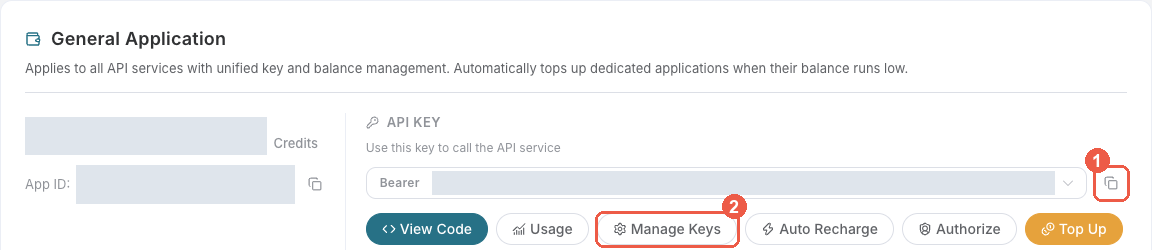
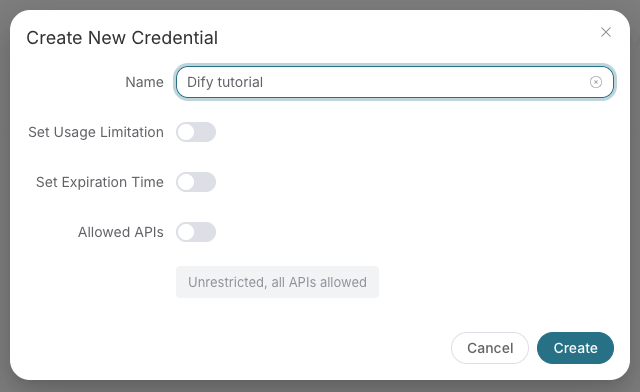
Save the key in the client's credential store or the environment variable shown below. Never put it in a prompt, shared workflow, screenshot, or Git commit. If authentication fails, check the full copied value, application/service access, expiration, usage limit, and balance before creating another key.
A fixed Bearer header bypasses OAuth. If the header is invalid, remove it before trying browser sign-in; keep the saved credential private.
For Claude Code, the shell expands the token when you add the server; treat the saved user MCP config as a secret:
export ACEDATACLOUD_API_TOKEN='YOUR_API_TOKEN'
claude mcp add --transport http --scope user fish https://fish.mcp.acedata.cloud/mcp \
  --header "Authorization: Bearer $ACEDATACLOUD_API_TOKEN"
For a Claude Code project config, put a variable reference in <project>/.mcp.json and set that variable in the environment that launches Claude Code:
{
  "mcpServers": {
    "fish": {
      "type": "http",
      "url": "https://fish.mcp.acedata.cloud/mcp",
      "headers": {"Authorization": "Bearer ${ACEDATACLOUD_API_TOKEN}"}
    }
  }
}
Cursor uses a different environment-variable syntax in ~/.cursor/mcp.json or an uncommitted project config:
{
  "mcpServers": {
    "fish": {
      "url": "https://fish.mcp.acedata.cloud/mcp",
      "headers": {"Authorization": "Bearer ${env:ACEDATACLOUD_API_TOKEN}"}
    }
  }
}
In VS Code, run MCP: Open User Configuration and merge this server plus its masked input; ${input:...} is for VS Code's user/workspace format and is not portable to the Agent Host .mcp.json format:
{
  "inputs": [
    {"id": "acedata-fish-token", "type": "promptString", "description": "AceDataCloud API token", "password": true}
  ],
  "servers": {
    "fish": {
      "type": "http",
      "url": "https://fish.mcp.acedata.cloud/mcp",
      "headers": {"Authorization": "Bearer ${input:acedata-fish-token}"}
    }
  }
}
For Cline, use its MCP configuration UI or CLI file ~/.cline/data/settings/cline_mcp_settings.json; its remote transport value is streamableHttp. For JetBrains AI Assistant, add a remote URL from Settings → Tools → AI Assistant → Model Context Protocol (MCP). For Zed, use a context_servers entry with the URL only for OAuth or add a local Bearer header. These clients have different configuration schemas; follow their current UI rather than copying another client's JSON. Cline · JetBrains · Zed.
Install the package and give the local process an API token:
python -m pip install mcp-fish
export ACEDATACLOUD_API_TOKEN='YOUR_API_TOKEN'
mcp-fish
For Claude Desktop local MCP, merge this entry into the file opened by its developer settings (~/Library/Application Support/Claude/claude_desktop_config.json on macOS). uvx requires uv on PATH:
{
  "mcpServers": {
    "fish": {
      "command": "uvx",
      "args": ["mcp-fish"],
      "env": {"ACEDATACLOUD_API_TOKEN": "YOUR_API_TOKEN"}
    }
  }
}
Keep this user-level file private. Self-hosted HTTP uses mcp-fish --transport http --port 8000; expose it only with suitable network and TLS controls. Local execution still calls the AceDataCloud API.
https://fish.mcp.acedata.cloud/healthreturning{"status":"ok"}checks endpoint reachability only.- Confirm that the MCP client loads tools.
fish_get_usage_guideis a reference tool; it does not verify downstream API access or balance. - If you need a full API check, call
fish_generate_audiowith your own valid input after reviewing current service documentation and displayed pricing. If the result contains a task ID, callfish_get_taskon that same ID until terminal success or failure. Do not resubmit the operation just to check progress.
For 401, check which auth route the client used and whether the token or OAuth session is valid. A 403 may mean an account permission or content moderation failure; read the returned error. Insufficient balance and downstream service failures need their own diagnosis. A listed tool or submitted task does not prove a successful result.
| Tool | Description |
|---|---|
fish_generate_audio |
Generate speech from text via a Fish voice model |
fish_list_models |
List available Fish voice models |
fish_get_model |
Fetch metadata for a specific Fish voice model |
fish_get_task |
Get the status / result of a generation task |
fish_get_tasks_batch |
Batch-fetch the status / result of multiple tasks |
fish_get_usage_guide |
Get the API usage guide |
MIT — see LICENSE at the repository root.