
Official SDK clients for the AceDataCloud API.
- Open Ace Data Cloud → Applications. Sign in, or register an account first.
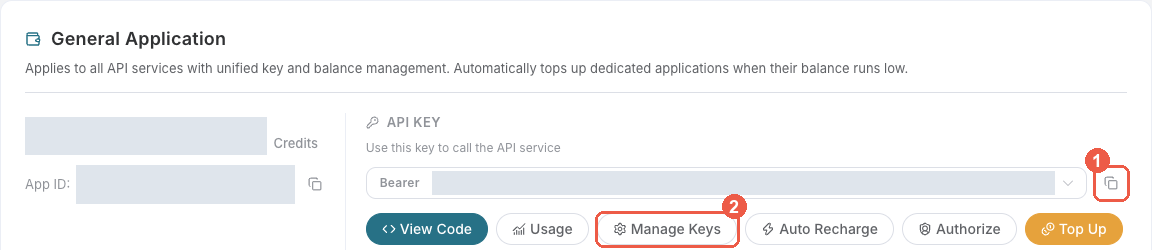
- Find General application. If it has not been created, choose Initialize General Application. A general key can use the services available to your account; a dedicated application's key is limited to its service. Check the required service/model access and current pricing.
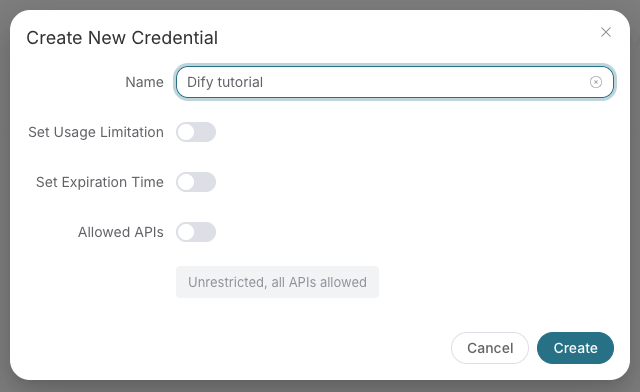
- Copy the API Key from the application card, or open Keys / Manage Keys → Create to create a separate key for this integration. Give it a recognizable name so you can revoke or rotate it independently.
- When creating a key, review Expiration Time, Set Usage Limitation, and Allowed APIs. Enable only the restrictions you need, allow the operations you will call, then click Create and copy the token from the key list. Task lookup does not grant permission to submit a generation. Confirm the application's balance can cover your first request; any trial allowance is whatever your account currently displays.
- Copy only the token value, without quotation marks, spaces, or
Bearer. An API Key / API Token field expects this raw value; only a manually configured HTTPAuthorizationheader needs theBearerprefix. Aplatform-...account-management token cannot replace a generation API key.
Save the key in the client's credential store or the environment variable shown below. Never put it in a prompt, shared workflow, screenshot, or Git commit. If authentication fails, check the full copied value, application/service access, expiration, usage limit, and balance before creating another key.
Use this application key for API requests. SDK account-management methods require the separate credential described in their management documentation; do not interchange it with the API key. The optional x402 payment flow below is a separate way to pay for supported requests.
| Language | Directory | Package |
|---|---|---|
| Python | python | acedatacloud |
| TypeScript | typescript | @acedatacloud/sdk |
| Go | go | github.com/AceDataCloud/SDK/go |
All three SDKs share the same design, organised along two axes:
client
│
├── ── provider axis — one namespace per service, fully typed ──
│   ├── kling       # every Kling parameter, validated
│   ├── veo         # generate / upsample / extend / reshoot / objects
│   ├── glm
│   └── openai      # OpenAI-compatible completions & responses
│
├── ── modality axis — pick a provider at call time ──
│   ├── images      # images.generate(prompt=..., provider="flux")
│   ├── audio
│   ├── video
│   └── chat
│
└── ── cross-cutting ──
    ├── search      # Web search
    ├── tasks       # Cross-service task retrieval
    ├── files       # File uploads
    └── platform    # Applications, credentials, models, config
The provider axis is the primary surface: services in the same modality do
not share a parameter set (Kling has cfg_scale and camera_control, Flux has
size and count), so each gets a closed, precisely typed signature.
The modality axis is a convenience wrapper over it, for callers who just
want "generate an image" and are happy with common parameters plus a
provider= switch. It delegates rather than reimplementing.
- Task-based generation: Image/audio/video endpoints return a
TaskHandlethat polls until completion - SSE streaming: Chat and OpenAI-compat endpoints support streaming via Server-Sent Events
- Automatic retries: Transient errors (5xx, network) are retried with exponential backoff + jitter
- Error hierarchy: Typed errors for auth, rate-limit, balance, validation, moderation, etc.
- Dual base URLs: calling plane (
x402.acedata.cloud) and management plane (platform.acedata.cloud) - Pluggable payment handler: on
402 Payment Required, the SDK invokes an optional handler to produce the retry headers — the integration point for on-chain (x402) payments
Both SDKs expose a paymentHandler / payment_handler hook that is
called when the server returns 402 Payment Required. Plug in
@acedatacloud/x402-client
and the SDK can call any x402-enabled endpoint using on-chain USDC
instead of a Bearer token — no other code changes needed.
import { AceDataCloud } from '@acedatacloud/sdk';
import { createX402PaymentHandler } from '@acedatacloud/x402-client';

const client = new AceDataCloud({
  paymentHandler: createX402PaymentHandler({
    network: 'base',
    evmProvider: window.ethereum,
    evmAddress: '0xYourAddress...',
  }),
});

await client.openai.chat.completions.create({
  model: 'gpt-4o-mini',
  messages: [{ role: 'user', content: 'hi' }],
});
In Python the hook is the same shape — any callable that returns
{"headers": {"X-Payment": "<base64-envelope>"}}. See
python/README.md.
Most provider-axis clients are generated for Python, TypeScript, and Go from the
pinned OpenAPI snapshots in scripts/specs and the curated
scripts/services.json manifest:
python3 scripts/generate_providers.py \
  --manifest scripts/services.json \
  --specs scripts/specs \
  --languages python,typescript,go
Kling, OpenAI, Serp, ShortURL, WebExtrator, and Veo remain hand-written because they contain validation or helper behavior that the selected OpenAPI operations do not fully express. CI reruns the generator and requires a clean working tree.
The older files in spec/overlays are inactive design artifacts; they are not generator inputs and cover only the original nine domains.
PlatformBackend's daily ecosystem CronJob prepares incremental capability PRs using a pinned Backend source. Existing CI and human review gate each update. The previous dispatch/Copilot sync workflows are retired.
For an offline preview, use a clean SDK checkout and a PlatformBackend checkout at the source SHA:
python3 scripts/sync_from_platformbackend.py --backend-dir ../PlatformBackend --services flux
python3 scripts/generate_providers.py --manifest scripts/services.json --specs scripts/specs --languages python,typescript,go
The curated manifest is not expanded automatically. New endpoints and the six hand-written client families above need review; missing or moved operations fail before any snapshot is written. A schema removal or stricter parameter may be a breaking API change, so generated PRs remain drafts until compatibility is checked.
PlatformBackend ecosystem.py is the only scheduled coordinator.
One daily Kubernetes Job reviews Backend docs and API changes with Claude Code,
updates existing files, and creates or updates one reviewable PR per repository.
It never merges PRs or duplicates the Backend guide tree. Normal CI and review
remain required; publication and sub-repository mirroring run after merge.