
Adaptive Authorization & Runtime Guardrails for AI Coding Agents






Your AI coding agent can rm -rf your repo, leak your API keys, or get prompt-injected into exfiltrating data, autonomously, with no undo. Doberman is the guard dog on the execution path, and it stops the dangerous call before it runs.
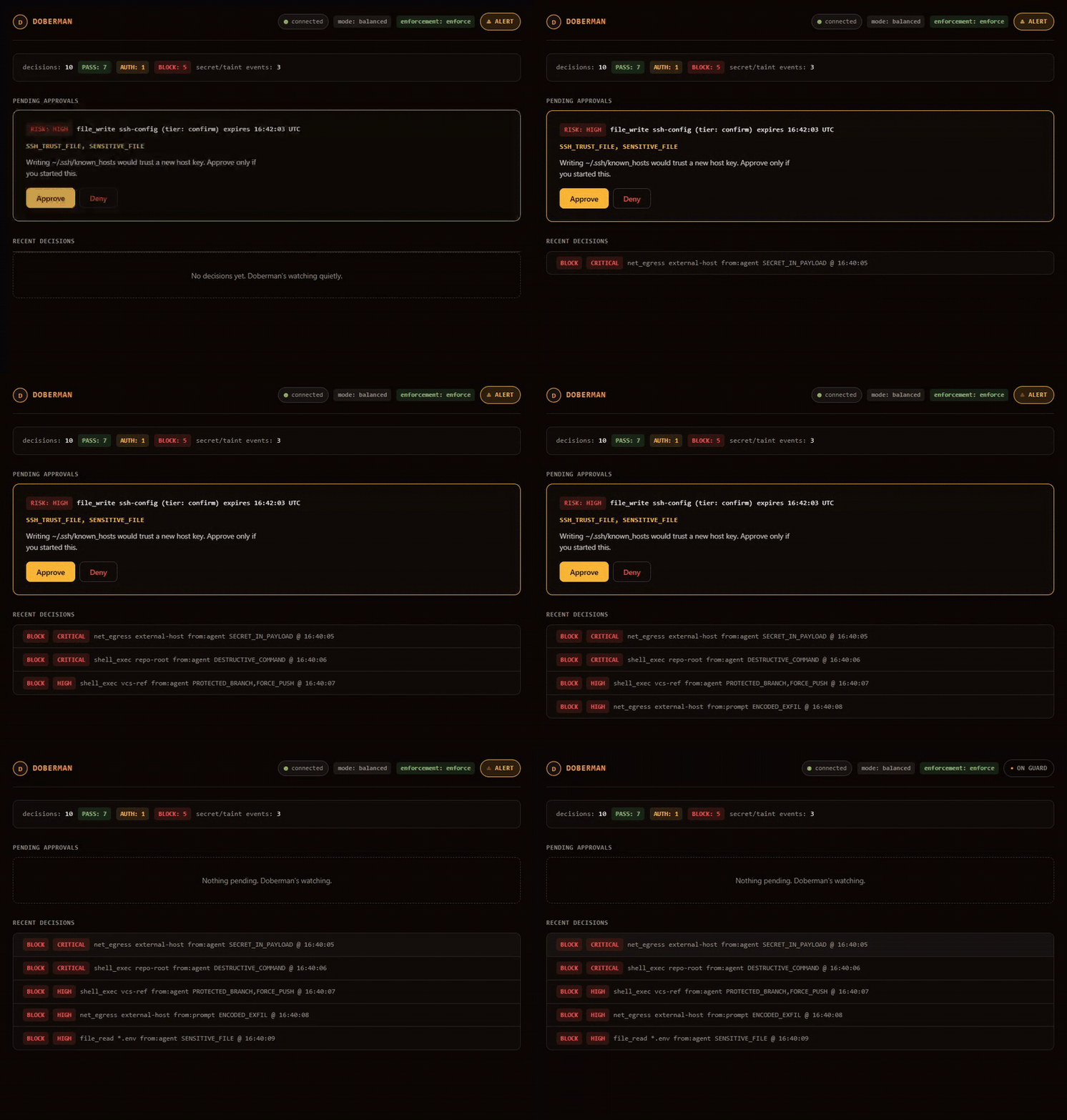
doberman demo against the live dashboard (doberman dash): five attacks blocked as they happen, then a human denies a high-risk approval.
A guardrail that isn't on the execution path can only advise.
Doberman sits between the agent and its tools (a transparent MCP proxy or host hook) and turns every action into an explicit, auditable decision. Every tool call gets exactly one verdict, decided before it executes:
| Verdict | What happens |
|---|---|
PASS |
Routine work, straight through, zero friction. |
AUTH |
Sensitive, paused for your approval. Repeat the exact same action within five minutes and it re-prompts with a one-click confirm (never for destructive work). |
BLOCK |
Dangerous, stopped cold. It never runs. |
AI agent ──▶ Doberman ──▶ real tools (files, shell, MCP servers, APIs)
                 └─ normalize → risk engine → PASS / AUTH / BLOCK
Works with Claude Code, Codex, OpenClaw, and any MCP-compatible agent. Cursor and other MCP clients connect through the MCP proxy. It's open source, local first, and holds two guarantees: it fails closed (uncertainty denies) and is raise-only (it can tighten automatically, but never silently loosens).
- Why Doberman: what it does, and the two guarantees
- Quick start: install and protect an agent in two commands
- Verify it end-to-end: watch it front a real MCP server
- Turn gate: the optional pre-inference chokepoint
- Benchmark: attack-block rate vs. false-positive friction
- Write a guardrail plugin: register your own rule or audit sink
- Tune to your risk tolerance: strictness modes and the enforcement dial
- Who is this for
- Roadmap
- Contributing · License
Most "AI guardrails" inspect prompts and offer advice, after the model has already decided. Doberman sits on the tool-execution path instead, so a blocked action never runs, no matter how it talked its way past the model's own guardrails first. Two properties make that a guarantee:
- Fail closed: any error, uncertainty, or unhandled case denies the action. There's no path to a
tool around the decision engine. This includes silence: an approval prompt nobody answers is bounded
by a hard deadline (2 minutes for the desktop dialog, 20 minutes as the whole-challenge backstop)
and resolves to a denial, logged distinctly as
timeoutrather thandenied. A hung prompt is not a denial, and agents usually run unattended, so the deadline matters. - Raise-only learning: guardrails and adaptive learning can auto-tighten, never silently loosen. Every permanent policy weakening requires explicit, possession-factor-gated, audited human approval (TOTP if enrolled, otherwise the local Doberman password).
The parity matrix maps each protection to each host Doberman fronts (Claude Code, Codex, MCP proxy, OpenClaw). Every checkmark links to the CI test that proves it; open cells are contributor-sized work, and the matrix regenerates from those tests on every build, so it cannot drift from what is proven.
Doberman guards any MCP-compatible coding agent: pick your agent, run one command, and every tool call is reviewed before it executes. The full walkthrough (every option and flag, the dashboard, health checks) is the Setup guide.
pip install doberman-coreAfter installing, run doberman --install-completion to enable shell tab completion.
Note Run
doberman uninstall --globalto remove Doberman from the whole machine. It removes the writable Claude Code and Codex hooks, project and device state, and enrolled factors before it removes thedoberman-corepackage with pip or pipx. Uninstalling the package first leaves hooks pointing at a missing binary. Already hit this? Reinstalldoberman-core, then run the global uninstall;doberman doctorflags any hook entry whosedobermanis not on PATH. More recovery steps: Recover.
| Your agent | How Doberman plugs in | Get started |
|---|---|---|
| Claude Code | Hooks: gates every built-in and MCP tool call (recommended) | doberman setup → guide |
| Codex CLI | Native PreToolUse hook (experimental) | doberman install-hooks --host codex |
| Claude Desktop / Cursor | MCP proxy: wraps your tool server | doberman serve -- <your-server> → guide |
| OpenClaw | Native plugin adapter | guide · adapter |
| Any MCP-compatible agent | MCP proxy | guide |
Fastest path (Claude Code):
doberman setup # pick a strictness mode, tune guardrails, wire the hooksAnonymous usage counts are on by default (command names and daily totals, never paths, prompts, or
secrets); the first command prints a notice, and doberman telemetry off or DO_NOT_TRACK=1 turns
them off. See Telemetry.
Doberman now reviews every tool call your agent makes. Confirm it with doberman doctor, or watch
real verdicts with doberman demo. MCP-proxy wiring, the dashboard, the TUI, scan, and 2FA are in the
Setup guide. Pending-approval cards in the dashboard can copy their already-redacted
decision details as JSON for review handoffs without exposing raw targets or paths.
Two ways to watch Doberman front a real MCP server, with no in-process test doubles anywhere in the chain.
Interactive demo (MCP Inspector and a real filesystem server):
npx -y @modelcontextprotocol/inspector doberman serve -- npx -y @modelcontextprotocol/server-filesystem ~/my-projectOpen the Inspector UI and call tools through Doberman: routine reads and writes pass straight through to the real filesystem server; a destructive call comes back as a policy error and never executes.
End-to-end test (in a dev checkout):
pytest tests/integration/test_serve_end_to_end.py -qThis spawns doberman serve as a real subprocess fronting a real stdio tool server
(tests/fixtures/stdio_tool_server.py), connects to it with a
real MCP client playing the agent, and asserts the deployable chain over actual stdio: the
downstream's tools are re-exposed through the proxy, a PASS verdict reaches the tool (the
downstream's call log records it), and a BLOCK verdict (rm -rf /) never reaches it, the call log
stays empty. That last assertion is the chokepoint property the whole project hangs on.
Note The rest of the integration suite deliberately uses an in-process fake downstream (
tests/fixtures/fake_tool_server.py) that records every call it executes, so the tests can prove a blocked action reached nothing. It's a test fixture, not the runtime.doberman servealways spawns and talks to the real server you give it after--.
Doberman's proxy speaks MCP as pinned in pyproject.toml (mcp>=1.27,<2). Its cross-call protections
(taint ledger, read-vs-send fingerprints, decision log) key off repo-local identity, never the
protocol session, and are regression-tested stateless.
Operators can bound retained decision rows with doberman decision-log-prune; it deletes only
resolved decisions and never pending AUTH rows or the append-only policy-change ledger. See the
CLI reference for the age and row-budget options.
A second invocation point for the same decision engine, consulted at a host pre-inference hook on the user's turn (prompt plus attached, pasted, or tool-fetched content), so a flagrant turn is judged before a single inference token is spent. The turn gate is an efficiency and early-warning layer with a deliberately narrow guarantee: no Tier-0-signature turn reaches the model. The action gate above remains the safety guarantee: an attacker who evades the turn gate still meets it. Full mechanism, module map, and invariants: Turn gate.
A suite-agnostic harness scores Doberman as a filter over labeled actions and reports attack bypass rate and benign over-block rate, running the real decision engine over each labeled tool call so the gated path is deterministic and offline. A labeled detection corpus turns it into a per-category detection-quality measurement, and CI gates on any regression. Commands, methodology, and published results (failure cases before wins): Benchmarks.
Third-party rules register through the doberman.rules entry-point group; core never imports your
package by name. A five-minute worked example lives at
examples/plugin-guardrail/, and the same entry-point pattern
(doberman.audit_sinks) forwards the redacted audit log to your own pipeline, for example a webhook.
Full walkthrough: Write a guardrail plugin.
Doberman ships with sane defaults, but every dial is yours to move: the strictness mode
(Light/Balanced/Strict/Paranoid), the enforcement dial (enforce/monitor/off), the opt-in default
role, the subjective prefs weights, tune's friction telemetry, and message-tone. Lowering any
of them requires a possession factor (TOTP if enrolled, otherwise the local Doberman password) and is
recorded in the append-only policy-change ledger; raising is always frictionless. Full reference:
Tune to your risk tolerance. Recovering from sticky taint, re-approving a changed
tool, resetting learned memory, or fully removing a project: Recover.
- Developers running AI coding agents who want autonomous agents without
rm -rfroulette. - Security engineers evaluating AI agent security, MCP security, LLM tool-use sandboxing, and zero-trust architectures for agentic AI.
- Platform teams deploying agent fleets who need policy enforcement, audit logs, and human-in-the-loop approval for destructive actions.
Planned and in-flight work now lives on GitHub: the Doberman Roadmap board (current focus: host-harness containment, subjective-layer hardening, the ambient-monitoring daemon, and the enterprise platform). For everything already shipped, see the changelog.
Doberman is defense-in-depth, not airtight: no single rule is a guarantee. The concrete, currently-known gaps:
-
Whole-script homoglyph confusables. The deterministic check catches intra-token mixed-script confusables (e.g.
раypal, which mixes Cyrillic and Latin). But a token rendered entirely in one non-Latin script that mimics a Latin word (e.g. an all-Cyrillic look-alike ofpaypal) is NFKC-stable and is not caught by the core deterministic check today. Closing it is planned via a perplexity/confusable detector. -
Bare high-entropy hex and other structured ids. To avoid flagging git SHAs, content/AST digests, MD5s, and UUIDs — the most common weak-path false positive, which also poisoned the multi-step taint ledger — the generic high-entropy heuristic ignores a token that is entirely hash-shaped hex (≥ 32 chars) or a dashed UUID. A real secret that is bare hex- or UUID-shaped with no surrounding credential name is therefore not stepped up by this heuristic alone; it is still caught when it carries a credential key-name (e.g.
API_KEY=…), matches a known credential shape, or is later matched by the read-vs-send fingerprint. (Lowering the floor from 40 to 32 also lets a bare 128-bit hex value pass the weak path; the strong credential-shape path is unaffected.) -
Identifier, path, and
word+numbershapes are exempt from the weak path (a raise-only, measured cost). Shannon entropy per character measures alphabet variety, not randomness, so an ordinary identifier, a relative path, or a build tag likepy311/x86lands in the same 3.6–4.5 bits/char band as a short base64 token and used to trip a spuriouspossible_high_entropy_secret— roughly 6:1 in the field, the source of the alert fatigue that trains a human to approve without reading. A token is now exempt only when every separator-split segment is a word, a number, a short length-cappedword+numberatom, or a digest/UUID id; a long base64/JWT segment fails, so the token is judged whole and no secret is fragmented below the length floor. The measured cost: the fraction of a bare base64url secret (no key-name, no known prefix) whose every segment happens to pass rises from ~0.8% to ~3.6% at 24 chars, ~0.2% to ~0.9% at 32, and ~0.01% to ~0.1% at 43 — the strong credential-shape path is untouched. On an egress path the exemption is withheld for a word-joined token (a passphrase has the same shape) but kept for a/-bearing token, since a filesystem path, URL path, or git ref is not a passphrase — which is what stops everygh apicall and branch ref from prompting on a push. -
Oversized encoded-blob detection is defense-in-depth, and evadable. The
Base64BlobDetectorsteps a large base64-looking argument up toAUTH(tolerating PEM/MIME newline wrapping), but it reasons about shape and size only: it never decodes the payload. It targets bulk file/secret dumps, not small credentials (those are the objective secrets rule's job), and an attacker can still evade it by splitting the payload across several sub-threshold arguments/calls, interleaving non-alphabet separators, or switching encodings. Raise-onlyAUTH, never a guarantee. -
Bare-token fixture/pattern-text suppression is WEAK-path only, and marker-gated on the residual. A bare (non-assignment) token that is regex-pattern source text being quoted (e.g.
sk-ant-[A-Za-z0-9_-]{20,}) or an obvious hand-written fixture is not stepped up by the high-entropy heuristic alone (#73). Because a fixture marker (EXAMPLE/SAMPLE/FAKE/DUMMY) and ordered0-9/a-zfiller are attacker-controllable (and for a shapeless secret the high-entropy heuristic is the only signal), a marker on its own is not trusted: the token is suppressed only when, after stripping the markers and ascending runs, the residual is too short/low-entropy to be a secret. A real key padded withEXAMPLEkeeps a high-entropy residual and still fires, and a variable merely named with a marker never suppresses its value (the check runs on the RHS after the=split). The suppression also never touches the STRONG credential-shape path, which can still drivesecret_exfiltration. Regex-pattern source ([]{}\) is suppressed unconditionally: the tokenizer charset can't produce those characters in a real token. A full live-shaped example key quoted in prose with no marker is still indistinguishable from a real one and steps up. -
Static egress classification, not a runtime egress broker. Doberman now reads the external destination out of shell / package / git commands too, not just
network_requestcalls. The direct-egress verb set spans HTTP/copy tools (curl/wget/scp/sftp/rsync) and raw socket/shell channels (nc/ncat/netcat/ssh/telnet/ftp/tftp/socat), so a secret piped tocurl <host>(ornc host port) is a hard BLOCK, and any such command egress (even to a trusted-looking host, or one it cannot resolve to a single route, e.g. a barenc host portorssh -Rtunnel with no URL) steps up to authentication. This is raise-only: it never mints a new silent allow, and ambiguity fails toward the human. But it is a static parse of the command string: it can flag "this looks like egress" yet cannot prove the host it classified is the socket the process actually opens. A redirect file,--resolve/--connect-to, anHTTP(S)_PROXY/ALL_PROXYoverride, DNS rebinding, a URL built at runtime,git pushto an already-configured origin, a package lifecycle script, a trusted tenant abused as a channel, or egress from a spawned child process can all still route around the static classifier. Non-verb channels also remain uncovered: DNS-label exfil (dig/host/nslookupTXT lookups), bash's built-in/dev/tcp, andopenssl s_clientpresent no recognizable egress verb, so static classification does not see them. Real containment needs a runtime egress broker (planned: theEgressBrokerseam and its entry-point group,doberman.egress_brokers, now exist and are consulted on every egress-classified action. A registered broker's retrospective ground-truth signal, what an entity's connections actually showed a moment ago, can now raise a decision towardAUTHwhen it diverges from the static classification, but a broker verdict still cannot lower one or grant aPASSon its own). A concrete core reference broker's building blocks now exist too: a default-deny allowlist, a two-sided enforcement probe (a direct connection must fail and a broker-routed one must succeed), and now a real listener: a minimal, stdlib-onlyasyncioHTTPCONNECTforward proxy (doberman.egress.proxy.ForwardProxy) that enforces the allowlist at the socket, so a denied destination's upstream connection is never opened. It isCONNECT-only (no SOCKS) and has no transparent/SNI-sniffing mode (it can only mediate traffic explicitly routed to it), and it still ships unregistered as adoberman.egress_brokersentry point in core (opt-in wiring only). PASS-authority now exists (RB.4): a registered broker can letExternalDestinationRulecontributePASSinstead of its usual AUTH, but only when the broker isPROVENto enforce egress and its verdict both allowlists and will itself enforce this exact destination at the socket: a bare allowlist claim from an unproven or non-enforcing broker still stays AUTH, and RB.3's route-divergence check always wins over a broker PASS. Paranoid mode (RB.5) can now escalate a non-allowlisted destination all the way to a hard BLOCK, but only under the mirror-image condition (aPROVEN,will_enforce-attesting broker), so the escalation is never a bare mode toggle pretending to be real enforcement; with no broker registered, Paranoid is unchanged from every other mode. A registered broker's retrospective connection history now also feeds a bounded, in-memory per-entity velocity check (RB.6): burst/volume/fan-out over the same recent window can raise aPASStoAUTH(winning even over a broker-backedPASS) or append a reason code onto an already-AUTH/BLOCKresult, never lower one, and it is silent with no broker or noconnection_events(). -
Artifact digest verification (RB.7) is post-fetch and opt-in: it does not, and cannot, verify content before the fetch decision. A
PASSon anetwork_requestaction is granted before the fetch happens, and the RB.2bForwardProxybroker is an HTTPCONNECTproxy that relays TLS opaquely: it never sees plaintext response bytes, so it cannot inspect or verify a payload pre-decision (that would require TLS MITM interception, deliberately out of scope for this feature). What Doberman does instead: at the same point the existing output secret-scan runs (after the downstream tool call returns), it compares the fetched RESULT text's sha256 digest against any pin an operator configured in.doberman/artifact_pins.yaml. A mismatch withholds the content from the agent; a match passes it through. Any artifact without a configured pin is not verified at all: this is a narrow, explicit-allowlist integrity check, not a general supply-chain guarantee, and with no pins file present behavior is completely unchanged. -
Egress behind a flag-taking transparent wrapper steps up to AUTH: static classification is still bypassable. When an egress command is invoked through a wrapper that takes its own flags (e.g.
sudo -u www-data curl …,nice -n 10 curl …,ionice -c 2 wget …), the wrapper's option shifts argv so the option is misread as the command. Doberman detects the hidden command and steps it up to authentication when the shlex-normalized command tokens name a known egress tool, including a quote-split (cu''rl) or path-qualified (/usr/bin/curl) verb. This is raise-only (it never mints a new silent allow), but two honest limits remain: (1) static parsing cannot recover the wrapped command's host, so a wrapped secret exfiltration resolves to AUTH, not the hard BLOCK its un-wrapped form gets (the secret-exfil floor needs the host it cannot see); and (2) a verb obscured beyond token normalization, such as a nested shell (sh -c '…'), command substitution ($(…)), or a name assembled at runtime, can still evade the static classifier. Conversely, an egress name that appears only as an argument to a flag-taking wrapper (e.g.sudo -u www-data grep curl x, where argv-shifting makes the wrapper misreadcurlas the command) over-steps to AUTH: a deliberate fail-closed cost; a baregrep curl xwith no wrapper parses cleanly and is not flagged. Robust containment here needs the runtime egress broker (planned). -
The adaptive layer runs on the MCP proxy path, not the host-hook path. The Claude Code and OpenClaw hooks run the deterministic objective guardrail only: the per-entity behavioral baseline, surprise scoring, and drift detection (
doberman.subjective) are not consulted there. That's deliberate: aPreToolUsehook runs before every tool call, and importingnumpy/scipy/riverat module scope costs ~2s per call. Both hooks now share a single evaluate/record spine, so verdicts cannot drift between hosts. The hook path gives you the deterministic floor (path confinement, destructive-command detection, secret patterns, egress classification, role boundaries, the enforcement dial); adaptive escalation currently needs the proxy. Wiring the adaptive layer onto the hook path via a warm process is planned. -
Environment-dump detection is verb-based, not exhaustive.
env,printenv,export/export -p,declare -x/typeset -x, and the PowerShellEnv:drive listing step up to authentication before running. Deliberately out of scope for now: a bare POSIXset(lists shell variables and functions, but is also extremely common asset -e/set -euo pipefailin scripts — flagging it bare would be a high false-positive cost for a rarely-abused vector) and a Windowscmd.exebareset(same ambiguity). A literal trailing backslash (dir env:\) is not in the rule's Windows-path trigger list, so POSIX shlex parsing fails on it first and it falls back to the genericopaque_commandAUTH instead — still fails upward, just under a different reason code; the no-backslash form (dir env:) is unaffected. And, as with every objective rule, this is static command-text classification: it cannot see what an output later contains, so a program that readsos.environinternally and prints it (e.g. a Python one-liner with no recognizable verb) is not caught here — only by the post-execution output scan. -
The control plane is self-protected: a mediated agent cannot disable its own leash, but a human still can. Wherever an action routes through the decision engine, a write, delete, or read of Doberman's own state (
.doberman/) or a host's hook-and-trust config is hard-blocked, and the same check runs against a shell command that merely names one of those paths, sorm -rf .dobermanorecho > .claude/settings.jsonis caught too. The protected set now also recognizes the Codex CLI control plane (.codex/hooks.json,.codex/config.toml, and the.codex/plugin dirs are hard-blocked; the rest of.codex/**steps up to authentication), mirroring the.claude/.dobermansplit, so it is enforced the moment a Codex action reaches the engine. Note the front door matters: today that path covers Claude Code (hooks) and any MCP-wrapped tool server. A Codex CLI PreToolUse adapter now exists (doberman hook codex-pre; Codex's hook layer is a Claude Code compatibility shim, so it shares the same decision spine and deny shape), anddoberman install-hooks --host codexwires it into~/.codex/hooks.json(or a project-local one with--local) in one command. And the limit is honest even then: this stops the agent, not a human: someone at the keyboard can always disable a hook (e.g. Codex's own--dangerously-bypass-hook-trust), and a control-plane path built at runtime (from a shell variable, glob, or apython -cpayload) is not caught by static command parsing.
Start with CONTRIBUTING.md for local setup, CI checks, project invariants, and the PR workflow.
CI also runs python scripts/check_markdown_links.py, a deterministic offline check for
repository-local Markdown links and heading anchors. It skips external URLs and fenced code blocks
and never makes network requests.
Come say hi. Questions, ideas, a rule pack to share, or an attack you caught in the wild? Join the pack on Discord →. It's where the roadmap gets shaped.
Found a vulnerability or a way around a guardrail? Please report it privately: see SECURITY.md. Don't open a public issue or Discord post for a security report.
Apache-2.0. The core is standalone: no proprietary dependency (CI-enforced). Each release also ships a CycloneDX SBOM listing the exact dependency set, see SECURITY.md.