




I’m Adam Normandin. I build workflow software, agent infrastructure, and private inference systems at Optimized Workflow in New England.
My work sits between software and operations: define the job, build the execution path, test what happened, and leave evidence someone else can inspect. Before software, I worked in telecommunications infrastructure. That background still shapes how I think about reliability, field conditions, and handoffs.
Optimized Workflow · Engineering approach · X / @opworkflow
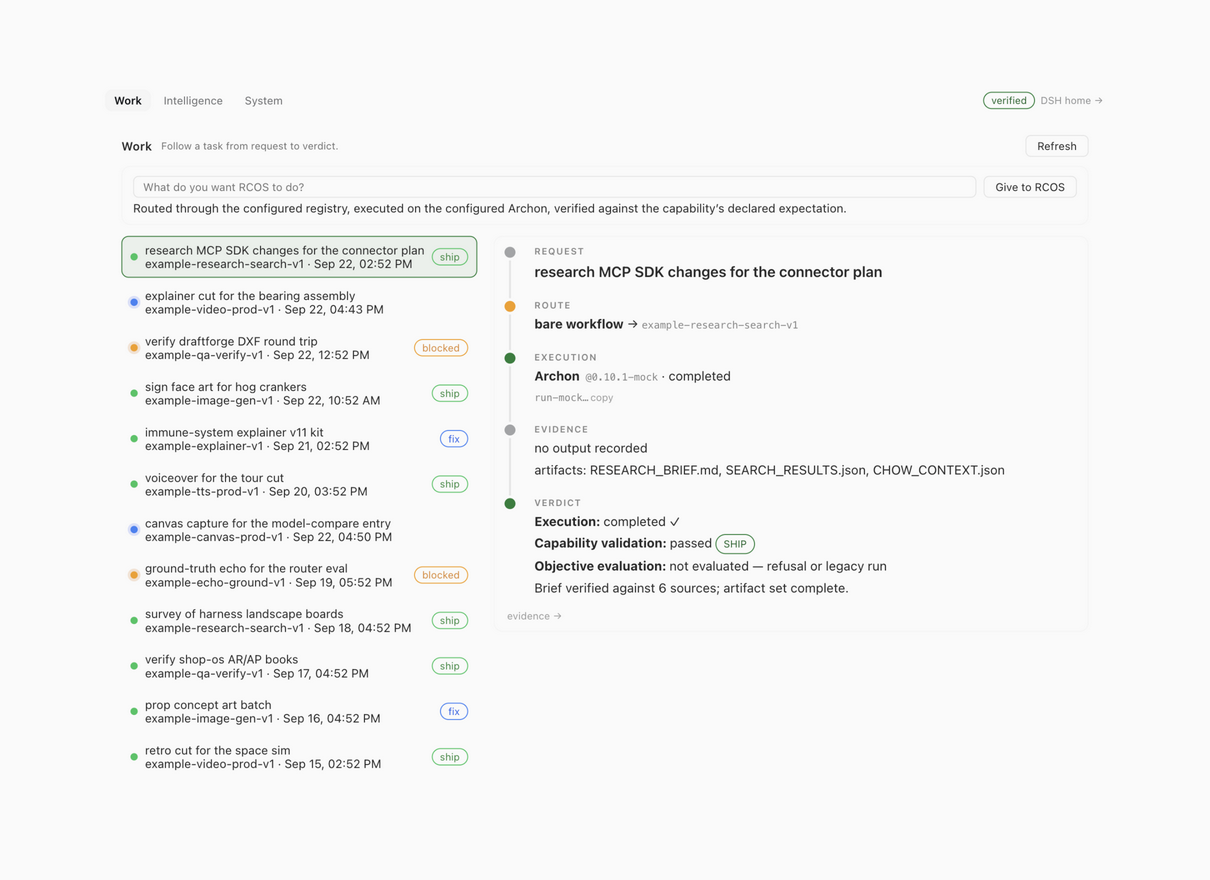
01 / DSH Operator UI Public integration surface for governed agent work: requests, routing, execution, evidence, and verdicts. The reproducible public install is the locked web-profile package; native Desktop integration is a development preview. |

02 / FlowRouter An open capability-manifest specification: inputs, execution contracts, routing metadata, and verifiable evidence. Version 0.1 is frozen; the repository includes its schema, examples, and validator. |

03 / Local inference Benchmarking open-weight models on available hardware, studying concurrency and memory behavior, and building private or hybrid serving paths. Measurements and configurations matter more than model-name rankings. |

04 / Media Factory A production workflow for motion and video: brief, assets, generation, assembly, and quality review. This is an active internal workstream, not a public installable product. |
Visual note: the DSH image is a public repository screenshot captured with sanitized fixtures. The other panels are editorial diagrams, not application screenshots or benchmark results.
| Working tools and systems | |
|---|---|
| Languages | Python · TypeScript / JavaScript · SQL · shell |
| Applications | React · Next.js · FastAPI · API integrations |
| Agents / evaluation | Tool-calling agents · workflow orchestration · test harnesses · structured evidence |
| Inference / infrastructure | Open-weight LLMs · NVIDIA CUDA · Apple MLX · local and hybrid deployments |
The largest research project is RCOS — Recursive Capability Operating System: an experimental system for routing agent work through authorized execution, evaluations, and inspectable receipts.
Intent → Route → Execute → Evaluate → Evidence
The canonical RCOS repository is private pending publication and fresh-install verification. The linked DSH Operator UI and FlowRouter repositories are public components with their own documented boundaries. Neither should be read as a general-availability RCOS release.
I also work on manufacturing software and deterministic CAD/CAM workflows. The operating principle is consistent: keep authority explicit, make failures visible, and verify outputs against the task.
Have a recurring workflow that needs proper engineering? optimizedworkflow.dev