

DSTF is regression and unit testing for the behaviour of time-dependent systems: Modelica libraries, FMUs, Julia models, or anything Python can compute. It finds a library's tests, simulates them with a backend — Dymola, OpenModelica, FMPy, Julia or Python, or one a plug-in adds — and scores each result against a stored baseline by the criteria you write. It reports a verdict per test on the command line, as JUnit XML for CI, and as a dashboard and a page per test in the browser.
DSTF is in beta: the command line and the testing.json keys may still change between minor versions; the changelog says when.
$ uv tool install dynamic-systems-testing-frameworkor pipx install dynamic-systems-testing-framework. The command is dstf.
The author extra adds dstf author, a browser tool for writing criteria
beside the plots they score; fmpy and om add what the FMPy and
OpenModelica backends drive.
The Python example library needs no simulator. From a clone of this repository, in a Python environment with numpy and scipy:
$ git clone https://github.com/ORNL-Modelica/DynamicSystemsTestingFramework.git
$ cd DynamicSystemsTestingFramework
$ python3 -m pip install numpy scipy
$ dstf --config examples/python/PythonTestingLib/Resources/ReferenceResults/testing.json run
It runs three tests, compares each with its stored baseline, prints a verdict per test and opens the dashboard:
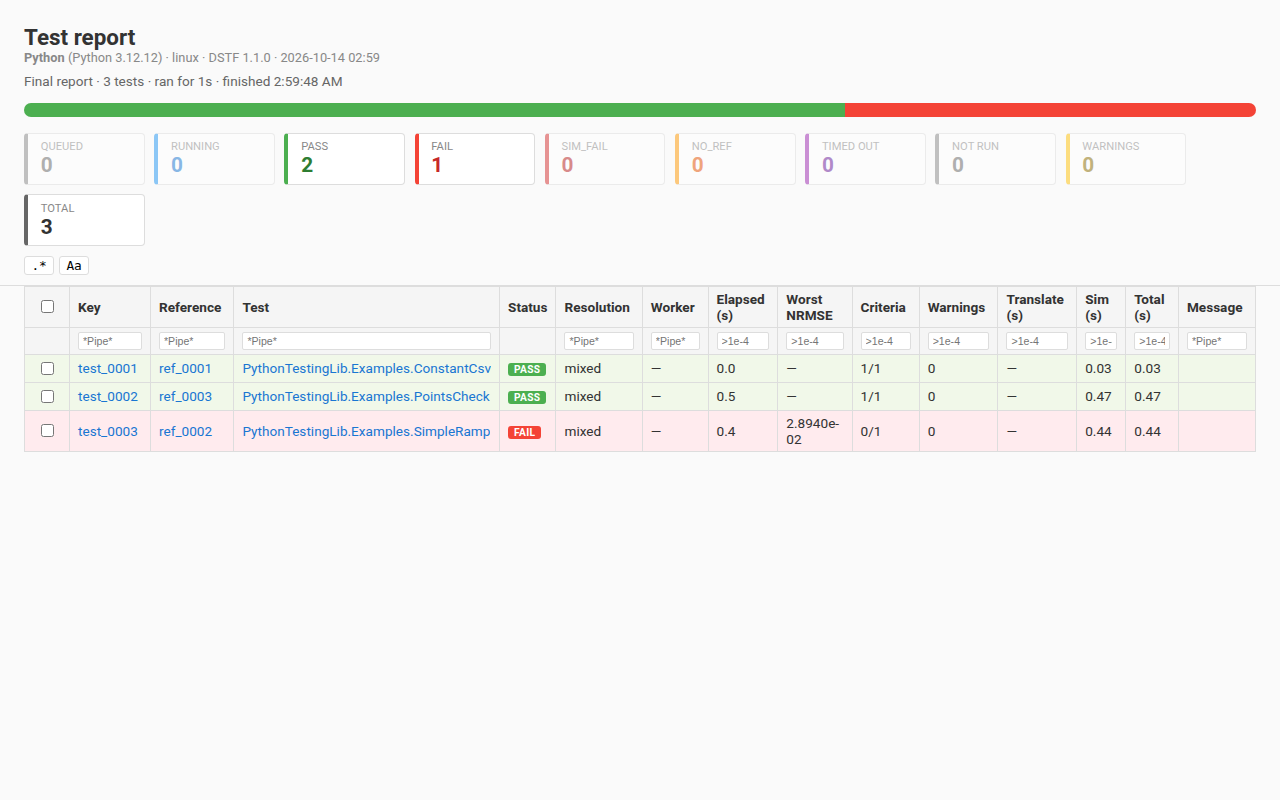
https://dstf.readthedocs.io/ — a first run, setting up testing.json for
your library, adding tests, reading results, baselines, criteria, CI, a page
per simulator, writing a backend plug-in, and a reference of every command,
key and comparison mode.
What changed in each version is in CHANGELOG.md. DSTF is released under the MIT licence: LICENSE.