


Standalone FFmpeg media player for Avalonia 12. It owns source resolution, streaming, playback lifecycle, cancellation and cleanup for local video/audio, HTTP media, seekable streams, DASH manifests and YouTube URLs.
dotnet add package FFmpegVideoPlayer.Avalonia --version 3.0.3Version 3 requires Avalonia 12.1.0+ (below 13) and .NET 8+. The single package contains the Avalonia control, Core and OpenTK/OpenAL audio implementation; applications do not reference separate player packages.
The managed player API is cross-platform, but the native payload is platform-specific: FFmpeg 8.1.2 DLLs are bundled only for Windows x64. Windows x86/ARM64, macOS, and Linux require a compatible system FFmpeg installation or an explicitly supplied native-library path. OpenAL Soft audio DLLs are bundled separately for Windows x64, x86, and ARM64.
YouTube video and audio are kept as separate adaptive streams, but FFmpeg reads the signed media URLs directly with HTTP range requests. This avoids downloading the same startup ranges through an intermediate proxy and preserves the selected stream's full quality.
1. Initialize FFmpeg (e.g. in Program.cs before the app starts):
using FFmpegVideoPlayer.Core;

FFmpegInitializer.Initialize();
2. Add the control in XAML:
xmlns:ffmpeg="clr-namespace:Avalonia.FFmpegVideoPlayer;assembly=Avalonia.FFmpegVideoPlayer"

<ffmpeg:VideoPlayerControl Source="C:\path\to\video.mp4" ShowControls="True" />
Video and audio-only files are both supported, for example .mp4, .mov, .mp3, .wav, .flac, .ogg, and .m4a.
Source also accepts direct HTTP(S) and YouTube URLs. Source changes are resolved
asynchronously and stale opens are cancelled automatically:
<ffmpeg:VideoPlayerControl
    Source="https://youtu.be/Ppejf4-YmSM"
    AutoPlay="True"
    ShowOpenButton="False" />
Applications with a small set of known tutorial videos can resolve their YouTube metadata in the background. This does not download the full video; it reads metadata and the small MP4 initialization/index ranges needed to prepare playback:
await YouTubeMediaSourceResolver.Instance.PreloadAsync(
    "https://youtu.be/Ppejf4-YmSM",
    cancellationToken);
For custom headers, in-memory media or manifests, use the typed API:
var source = MediaSource.FromUri(
    new Uri("https://media.example/video.mp4"),
    headers: new Dictionary<string, string> { ["Authorization"] = "Bearer …" });

var result = await player.OpenAsync(
    source,
    new MediaOpenOptions
    {
        OpenTimeout = TimeSpan.FromSeconds(20),
        ReadTimeout = TimeSpan.FromSeconds(30)
    },
    cancellationToken);
OpenAL Soft binaries for Windows x64, x86 and ARM64 are included in the package.
| Platform | Default |
|---|---|
| Windows x64 | Bundled DLLs in the package |
| Windows x86 / ARM64 | Compatible system FFmpeg 8 native libraries or a custom path |
| macOS (x64 / ARM64) | System/Homebrew (brew install ffmpeg); can auto-install |
| Linux (x64 / ARM64) | System packages (apt/dnf/pacman); can auto-install with passwordless sudo |
On every row except Windows x64, FFmpeg is a system/native prerequisite; it is not
contained in the NuGet package. Automatic installation, where supported, installs that
system prerequisite. The required FFmpeg 8 library ABI is avcodec-62, avformat-62,
avutil-60, swresample-6, and swscale-9.
Custom FFmpeg path:
FFmpegInitializer.Initialize(customPath: @"C:\ffmpeg\bin", useBundledBinaries: false);Subscribe to StatusChanged for progress during discovery or auto-install.
git clone https://github.com/jojomondag/FFmpegVideoPlayer.Avalonia.git
cd FFmpegVideoPlayer.Avalonia/examples/FFmpegVideoPlayerExample
dotnet runSources: Source for a path/URL, or typed Media for reusable
MediaSource recipes.
Lifecycle: PlaybackState, LastError, MediaOpening, MediaOpened,
FirstFramePresented, MediaFailed, PlaybackStateChanged, and MediaEnded.
Methods: OpenAsync, Open, OpenUri, CloseAsync, Play, Pause,
Stop, TogglePlayPause, Seek, and ToggleMute.
Presentation: AutoPlay, Volume, ShowControls, ShowOpenButton,
VideoStretch, VideoBackground, EnableKeyboardShortcuts, RenderingMode
(Cpu / OpenGL), AudioPlayerFactory, and IconProvider.
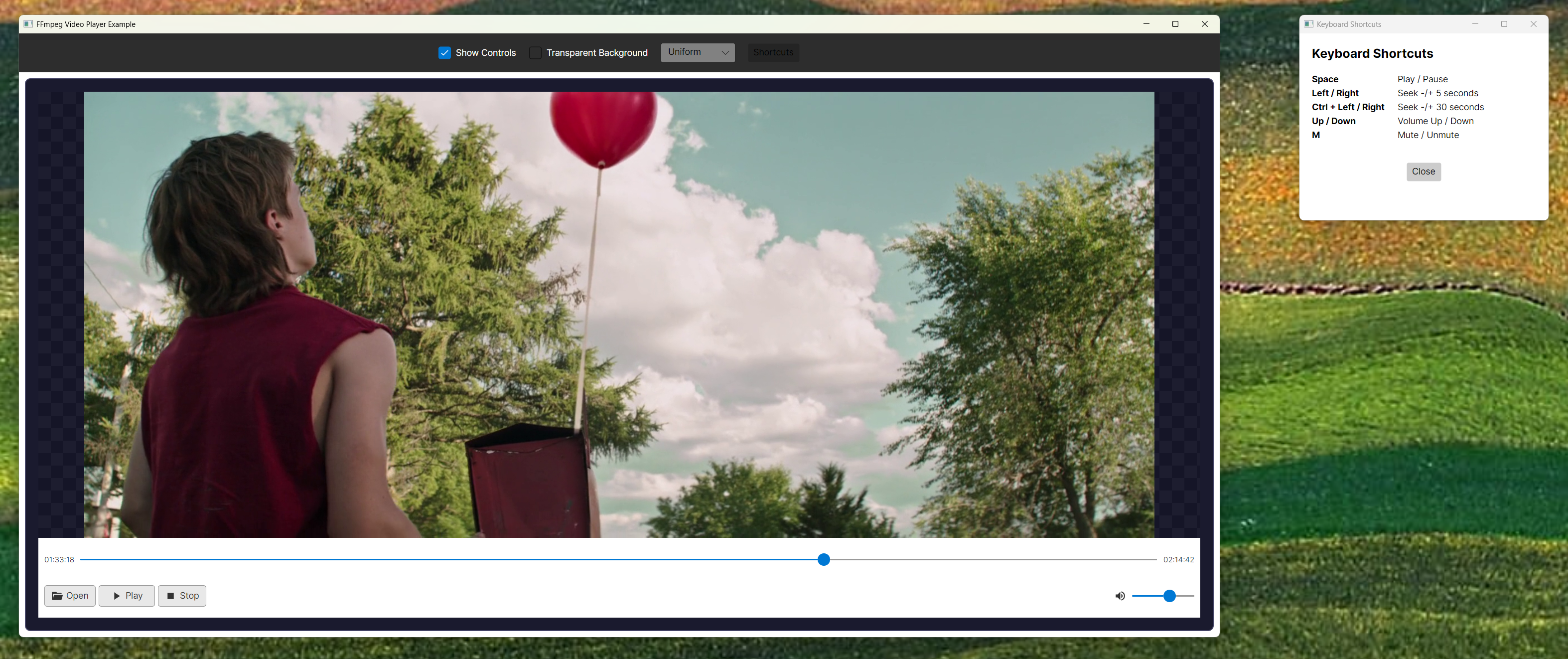
Shortcuts: Space (play/pause), arrow keys (seek/volume), M (mute)
Set AudioPlayerFactory to customize or disable audio. OpenAL via OpenTK is the default.
Custom icons: implement IIconProvider and set IconProvider.
The managed project code is licensed under MIT. The NuGet package also redistributes
FFmpeg and OpenAL Soft native libraries under their respective GNU LGPL terms. See
THIRD-PARTY-NOTICES.md for provenance, checksums, source
availability, replacement rights, and the packaged license-text locations.