Lizhi Yang, Junheng Li, Nehar Poddar, Yiling Hou, Gio Huh, Robert Griffin, Georgia Gkioxari, Aaron D. Ames — Caltech AMBER Lab & IHMC, 2026
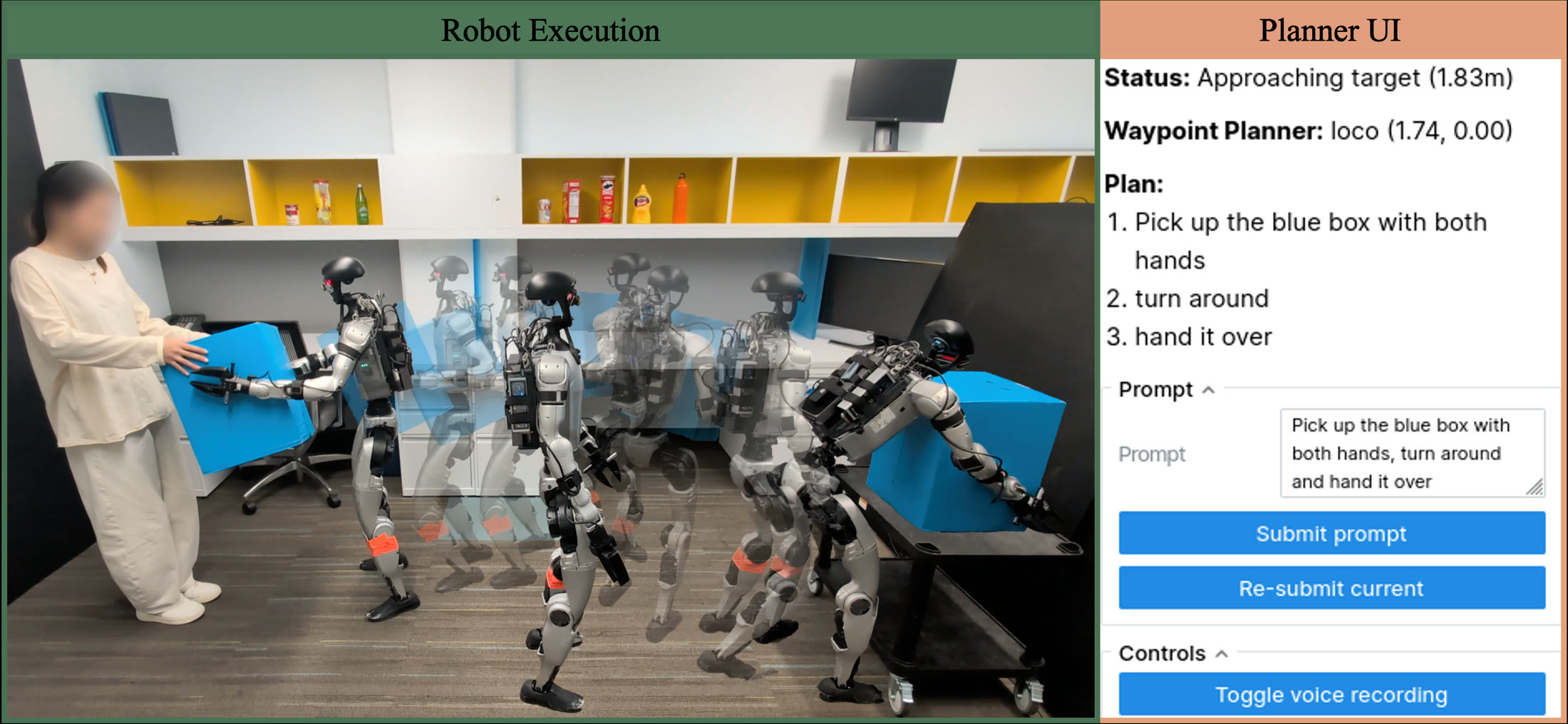
2026-06-10. The deployment policy has been updated. A freshly distilled
checkpoint is now bundled at deploy/ckpt/policy.onnx, and the deployment
scripts (deploy/play_sim_hand.sh, deploy/play_real_hand.sh) fall back to it
automatically when no local training run is found.
- Disclaimer: the bundled policy is provided for convenience and has been validated in simulation. Deploy on real hardware at your own risk — always verify behavior in sim first, keep an e-stop within reach, and start in a safe, clear workspace. (Sorry about the artifacts - seems to be a screen recording issue.)

Walking |

Squatting |

Bending down |

Fall recovery / get-up |
This is the framework for the HANDOFF paper (Humanoid Agentic Task-Space
Whole-Body Control via Distilled Complementary Teachers): the fully-stable,
seed-dataset, AMP-augmented three-teacher Mixture-of-Experts student for the
Unitree G1 (29 DoF) in MuJoCo. The student is one planner-friendly whole-body
controller that consumes a compact 10-D task-space command — planar base
velocity, root height, and bilateral pelvis-frame wrist targets
[v_x, v_y, ω_z, z, p_L, p_R] — and is distilled, under a context-conditioned
mixture-of-experts gating scheme, from three complementary specialists: a
whole-body motion-tracking teacher (trained on CoP-safety-filtered retargeted
clips), a locomotion teacher, and an AMP fall-recovery teacher.
The repository registers only four tasks — the three teachers plus the MoE student — and the source keeps only the term functions (observations / rewards / terminations / commands / events / curricula / actions) those tasks actually reference.
| Stage | Task id | Trains |
|---|---|---|
| Teacher 1 | Wbc-Teacher-Flat-Unitree-G1-Stable |
stable WBC (whole-body-control) teacher |
| Teacher 2 | Loco-Teacher-Flat-Unitree-G1-NoBV-Stable |
stable non-privileged (NoBV) locomotion teacher |
| Teacher 3 | Amp-Teacher-Flat-Unitree-G1 |
AMP recovery teacher |
| Student | Wbc-Hand-Dual-Teacher-Flat-Unitree-G1-MoE-UniCmd-NoBV-AMP-Stable |
3-teacher MoE student (split-KL distillation) |
"Stable" = whole-body stability rewards (CoM-in-support-polygon, capture-point-in-support-polygon, ankle/hip/step, linear & angular momentum change penalties) layered on the standard teacher reward mix. "Fully-stable" = the student trains under those rewards and distills from teachers that were themselves trained with them, so the KL targets are consistent with the env the student sees.
- uv for package management.
- The seed motion dataset (an external artifact, not in this repo):
/home/yangl/handoff/seed_g1_cbf_standing_payload/seed_dataset_filtered.yamlEvery training script points at this file via--env.commands.motion.motion-file. - A CUDA GPU. All scripts take the GPU id as the first positional arg (default 0)
and forward everything else to
uv run train.
uv sync # install mjlab + torch (and transitive deps) into .venvThe seed_dataset_filtered.yaml that every training script consumes is not a
raw mocap dump — it is the output of a preprocessing + safety-filtering pipeline
that turns raw SEED G1 motion-capture CSVs into stability-corrected reference
clips. The pipeline lives in two pieces:
src/wbc_mjlab/scripts/seed_enrich.py— the driver (CSV → enriched + filtered PKLs + YAMLs)src/wbc_mjlab/stability_offline.py— the offline capture-point / CoP correction library
WBC_ATTACH_PAYLOADS=1 uv run python -m wbc_mjlab.scripts.seed_enrich \
    --csv-dir ~/handoff/seed/g1/csv \
    --metadata ~/handoff/seed/seed_metadata_v003.csv \
    --output-dir ~/handoff/seed_g1_cbf_standing_payload \
    --fps 30 \
    --apply-correction --method cbf --trigger standing
WBC_ATTACH_PAYLOADS=1 is load-bearing for the correction: the
capture-point / CoP solver builds its CoM from a URDF, and only with the env
var set does it use the payload-weighted g1_29dof_rev_1_0_with_payloads.urdf
(Jetson on the back + Dex1-1 hands) instead of the bare g1_29dof_rev_1_0.urdf.
Since every training task runs payloads-on, the filter must too — otherwise the
corrected clips would be statically stable for a robot that isn't the one being
trained. (Enrichment FK in step 1 is mass-independent, so the env var only
affects the correction in step 4.)
It runs in one pass and does four things:
- Enrichment. Each CSV is loaded and MuJoCo forward kinematics is run on the
G1 model to add the world-frame body fields HANDOFF's
MotionLibexpects (local_body_pos,body_pos_w,body_quat_w), then written back as an enriched PKL. - Keyword pre-filter. Clips whose name/category match
REJECT_KEYWORDS(dancing,stunts,injure,crutch,kneel,crawl,on_all_fours) are dropped — these are motions a standing, payload-laden WBC G1 cannot or should not imitate. (jumpclips bypass the height check below.) - Quality post-filter. After conversion, a clip is rejected if its root
height leaves
[0.4, 0.9] mor its torso tilt ever exceeds100°— i.e. the subject went to the ground or inverted. - CoP / capture-point safety correction (
--apply-correction). For every quasi-static "standing" frame the solver runs Pinocchio FK, builds a conservatively shrunk support polygon from the foot-contact corners, and computes the signed distancehbetween the CoM projection and the polygon boundary. Wherehfalls below a safety target it solves a minimum-effort correction over a 7-DoF subspace (hip pitch, ankle pitch/roll, waist pitch) that restoresh ≥ h_tgtwhile re-anchoring the floating base so foot placements are preserved. Two interchangeable solvers are available (--method {lbfgsb,cbf}); the CBF one reuses the same analytic∇hand contact-consistent CoM Jacobian as the online training/deploy-time CBFs. A temporal blending mask smooths the boundaries of corrected segments.
Two YAMLs are emitted: seed_dataset.yaml (unfiltered — all converted clips)
and seed_dataset_filtered.yaml (passed both filters, correction applied). The
latter is the one the training scripts point at.
To apply the same correction to an existing HANDOFF YAML dataset (PKLs that are already enriched) rather than raw CSVs, use the sibling driver:
uv run python -m wbc_mjlab.scripts.enrich_pkl \
    --dataset /path/to/handoff_dataset.yaml \
    --output-dir /path/to/enriched/ \
--method cbf --trigger standingSim-to-real hardware payloads (Jetson on the back + Dex1-1 hands) are attached
to every task by default; set WBC_ATTACH_PAYLOADS=0 to disable.
# 1. Stable WBC teacher
./train_wbc_teacher_stable_seed.sh <GPU>
#    -> logs/rsl_rl/g1_wbc_teacher_stable_seed/<run>/

# 2. Stable NoBV locomotion teacher
./train_loco_teacher_nobv_stable_seed.sh <GPU>
#    -> logs/rsl_rl/g1_loco_teacher_nobv_stable_seed/<run>/

# 3. AMP recovery teacher (no -Stable variant exists; the AMP reward stack is
#    independent of the stability rewards)
./train_amp_teacher_flat.sh <GPU>
#    -> logs/rsl_rl/g1_amp_teacher_flat/<run>/

# 4. Point the student at the teacher checkpoints, then train it.
#    Edit ckpt_setup_stable_seed.sh and fill WBC_TEACHER_EXP / LOCO_TEACHER_NOBV_EXP
#    with the run-dir prefixes ("<date>_<time>_<run-name>") produced by steps 1-2.
#    (The AMP-teacher slot defaults are in ckpt_setup_stable_seed_amp.sh.)
./train_moe_student_unicmd_nobv_fullstable_seed_amp.sh <GPU>
# -> logs/rsl_rl/g1_hand_moe_flat_unicmd_nobv_fullstable_seed_amp/<run>/train_moe_student_unicmd_nobv_fullstable_seed_amp.sh sources
ckpt_setup_stable_seed_amp.sh, which sources ckpt_setup_stable_seed.sh:
train_moe_student_unicmd_nobv_fullstable_seed_amp.sh
└─ ckpt_setup_stable_seed_amp.sh   (fills AMP_TEACHER_* slot)
   └─ ckpt_setup_stable_seed.sh    (fills WBC_TEACHER_* + LOCO_TEACHER_NOBV_* slots)
You only ever run the four train_*.sh scripts; you edit the timestamps in
ckpt_setup_stable_seed.sh once between steps 3 and 4.
Note: hand-student runs degrade past ~20k iters. Scripts may run longer for visibility, but export from a deliberately picked checkpoint (e.g.
model_20000.pt), notmodel_-1.
Use mjlab's built-in native-viewer playback (no extra scripts needed):
uv run play Wbc-Hand-Dual-Teacher-Flat-Unitree-G1-MoE-UniCmd-NoBV-AMP-Stable \
  --checkpoint logs/rsl_rl/g1_hand_moe_flat_unicmd_nobv_fullstable_seed_amp/<run>/model_20000.pt
The same works for any of the four task ids.
Beyond the native-viewer playback above, the student policy can be driven
through the runtime stack under deploy/ — the same ONNX policy node talking to
either MuJoCo (sim2sim) or the physical Unitree G1 (sim2real), with an xbox pad
or a VR headset on the command bus. Both flows export ONNX from the latest
g1_hand_moe_flat_unicmd_nobv_fullstable_seed_amp run automatically (or take an
explicit .pt / .onnx path), then launch the policy, the sim/hardware node,
and the chosen controller.
Both scripts require ROS 2 (any of humble/iron/jazzy/rolling — auto-detected
and sourced) for the controller↔policy command topics; the high-rate
policy↔sim/hardware loop is UDP. Run uv sync first so the deploy deps
(onnxruntime, inputs, pin, televuer, websockets) are present.
bash deploy/play_sim_hand.sh                 # latest run, prompts for controller + run mode
bash deploy/play_sim_hand.sh model_20000.pt  # auto-export a specific checkpoint, then run
bash deploy/play_sim_hand.sh model.onnx      # run a pre-exported ONNX
Controller prompt: none, keyboard, xbox (local pad), vr (dds_xr headset
teleop), or xbox server (browser gamepad at http://localhost:8765). Run-mode
prompt: sync (sim+policy in one physics-synchronized process, default) or
split (policy and sim as separate UDP processes).
bash deploy/play_real_hand.sh                # latest run, prompts for net iface + grippers + controller
bash deploy/play_real_hand.sh model_20000.pt
One-time hardware setup builds the vendored Unitree SDK Python binding and the Dex1-1 gripper service (both pinned git submodules):
git submodule update --init deploy/real/unitree_sdk2_wrapper deploy/real/dex1_1_service
bash deploy/install_unitree_sdk.sh           # builds + installs unitree_interface .so and dex1_1_gripper_server
The script sets up policy-network routing (deploy/real/setup_route.sh), prompts
for the robot DDS interface (default enP2p1s0) and whether Dex1-1 grippers are
connected, then launches the gripper service (if present), the hand policy, the
hardware node, and the chosen controller (none / keyboard / xbox / vr).
Always verify a checkpoint in sim2sim before running it on hardware — a wrong obs/action layout shows up as a soft glitch in sim but a fall on the real G1.
Every controller is a ROS 2 node that publishes the same 18-float unified
command on /g1/command (planar base velocity, torso height, bilateral hand
targets, wrist RPY, grippers — layout in deploy/common/command.py); the policy
node subscribes and turns it into the 10-D task-space command the student
consumes. They differ only in how they fill that vector.
A gamepad mapped to incremental command edits, published at a fixed rate. Two input sources select the same mapping:
- local pad (
xbox): an evdev controller read through theinputslibrary on a background thread. - browser bridge (
xbox server): the sharedGamepadBridgeServerexposes a page athttp://localhost:8765; any W3C-Gamepad-API pad connected to that browser drives the robot over a websocket. The JS integrates triggers/D-pad locally and ships absolute values, so no controller need be plugged into the deploy host.
Mapping (both sources):
| Input | Command |
|---|---|
| Left stick X / Y | vy / vx (lateral / forward base velocity) |
| Right stick X | yaw_rate |
| LT / RT | torso height down / up |
| D-pad up-down / left-right | right-hand x (fwd/back) / y (lateral) |
| LB / RB | right-hand z (down / up) |
| Start / Back | reset all commands to defaults |
Sticks map to absolute velocities (with a deadzone); triggers, D-pad and
bumpers integrate the height and right-hand offsets at fixed speeds. The
left hand is mirrored from the right (same x/z, negated y), and all
state is clamped to the per-axis limits in teleop_common.py before the
nominal body pose is added and the command published.
A TeleVuer-driven XR teleop node. It hosts
a Vuer webserver (the https://<lan-ip>:8012?ws=... URLs are printed at
startup) that an XR headset connects to over WiFi; the headset streams head,
wrist and controller pose data back, which the node converts into commands. Two
modes:
- controller tracking (default): thumbsticks drive base velocity, tracked wrist poses drive the hand targets.
- hand tracking (
--use_hand_tracking 1): tracked wrists drive the hands, but base velocity is held at zero (no thumbstick axes exist).
Because XR poses are absolute in the headset frame, the node first runs a neutral calibration (averages ~30 samples of both wrists + head height) and thereafter commands deltas from neutral. Mapping:
- left / right thumbstick →
vx/vy/yaw_rate - tracked wrist positions → left / right hand targets (offset from the calibrated neutral, per-axis clamped)
- head height → torso height
- triggers → gripper opening (released = open, pressed = closed)
Four buttons act as mode toggles: X reset-hold (robot stands and ignores tracking — the safe default at startup), Y recalibrate neutral, A hand hold/follow, B wrist roll-pitch-yaw actuation. Outputs are heavily smoothed (velocity EMA, hand-offset and wrist-RPY low-pass, plus outlier-jump rejection on wrist orientation) so headset jitter doesn't reach the policy.
src/wbc_mjlab/
  __init__.py            # registers the 4 tasks (single source of truth)
  config.py              # env configs for the WBC / loco / student tasks
  amp_config.py          # env + runner config for the AMP teacher
  rl_cfg.py              # RSL-RL runner configs
  observations.py rewards.py terminations.py commands.py
  actions.py events.py curriculums.py amp_mdp.py   # MDP term functions
  g1_constants_custom.py # G1 PD gains, action scales, payload specs
  pkl_motion_lib.py      # motion-clip loader
  stability_offline.py   # offline CoP/capture-point safety-correction solvers
  scripts/               # data prep: seed_enrich.py (CSV->filtered), enrich_pkl.py
  rl/                    # DAgger + AMP runners, PPO algorithms, MoE network
deploy/                  # runtime stack for sim2sim / sim2real of the student
  play_sim_hand.sh       # sim2sim playback (xbox / vr / keyboard)
  play_real_hand.sh      # sim2real deployment on the physical G1
  install_unitree_sdk.sh # builds the vendored SDK + Dex1-1 gripper service
  export_onnx.py         # checkpoint .pt -> actor ONNX
  policy/hand_policy.py  # ONNX policy node (UDP loop)
  sim/                   # MuJoCo nodes: sim_node.py, sim_policy_node.py (sync)
  real/                  # hardware_node.py + unitree_sdk2_wrapper, dex1_1_service (submodules)
  controller/            # xbox_node.py, dds_xr_node.py (vr), keyboard_node.py
  common/command.py      # G1 command-vector layout (imported by g1_constants_custom)
  assets/                # G1 MuJoCo XML + URDF + meshes
src/wbc_mjlab/__init__.py is the entry index: mjlab discovers tasks via the
mjlab.tasks entry point in pyproject.toml. Training/playback go through
mjlab's uv run train / uv run play CLI.
If you use this code or build on HANDOFF, please cite:
@article{yang2026handoff,
  title   = {HANDOFF: Humanoid Agentic Task-Space Whole-Body Control via Distilled Complementary Teachers},
  author  = {Yang, Lizhi and Li, Junheng and Poddar, Nehar and Hou, Yiling and Huh, Gio and Griffin, Robert and Gkioxari, Georgia and Ames, Aaron D.},
  journal = {arXiv preprint arXiv:XXXX.XXXXX},
  year    = {2026},
  note    = {arXiv ID to be added}
}