Nudge it mid-run · hard-block what it must never do · get warned when it loops · keep every run in a SQLite file you own




Install · 60-second start · Guards · The cockpit · How it works
# terminal 1 — the agent is mid-task, and you can see it drifting
  ⏺ Edit(src/login/flow.ts)         ← wait, why is it in the login flow?

# terminal 2 — you, without killing the run
  $ reins steer "focus on the token refresh path — don't touch the login flow"
  ✓ queued — lands at the agent's next tool call

# terminal 1 — next tool boundary, same run, context intact
  ⏺ [reins — live steering from the developer] folded in
  ⏺ Edit(src/auth/refresh.ts)       ← back on course
Local-first. No daemon. No backend. No account. Nothing leaves your machine.
Reins guide a galloping horse without stopping it. That's the whole idea: nudge the agent while it runs, veto what it must never do, and keep a record — all from your terminal.
You're watching an agent work and you can see it drifting — over-engineering, editing the wrong module, about to run something destructive. Today your only options are to let it finish and clean up, or kill it and lose all its in-flight context.
reins gives you a middle path built from four Claude Code hooks:
| When | Reflex | What it does | Hardness |
|---|---|---|---|
| Before a tool runs | ⛔ Guard | Hard-vetoes forbidden commands/paths (rm -rf, writes to .env, …) — or escalates to you with --ask, or parks the action for your later approval with --hold (natively, via Claude Code's defer, where it's honored — deny-and-queue everywhere else) |
Hard veto (deny) / your call (ask) / your call, later (hold) |
| During the run | ✎ Steer | Injects a one-line course-correction at the next tool boundary | Soft — the model weighs it |
| After each tool | ⟳ Loop alarm | Warns inline when the same call repeats N times in a row | Observe + warn |
| At the end | ▶ Capture | Logs the run's trajectory + outcome to SQLite | Observe |
The steering is the headline. The SQLite log is a byproduct — you never have to open it for the tool to earn its place.
📖 The story behind reins — why the durable part turned out to be the gate, not the steering, and what a brutal self-review got right: I Built a Tool to Steer Running AI Agents. It Taught Me Where Their Real Cost Is.
npm install -g @manishky/reins
reins version
Prefer installing straight from GitHub?
npm install -g github:manishkumar/reinsworks too — no build step. Both put the samereinson your PATH.
Prefer a local checkout (for hacking on it)?
git clone https://github.com/manishkumar/reins && cd reins
npm install && npm run build && npm link
Requires Node ≥ 18. (Capture uses SQLite — built in on Node ≥ 22.5, optional on older Node; see Compatibility. Steering and guards work on any Node ≥ 18.)
cd your-project
reins init          # creates .reins/ AND wires the hooks into .claude/settings.json
reins init does the wiring for you — it merges the three hooks (PreToolUse, PostToolUse, Stop) into .claude/settings.json (creating it if needed, never clobbering existing settings). Then restart Claude Code in this project so it loads them.
Prefer to paste it yourself? reins init --print prints the block instead. Want it in settings.local.json (not committed)? reins init --local.
Now, the headline — steering:
-
Kick off any real task in Claude Code (e.g. "add token refresh to the auth module").
-
While it's running, in another terminal:
reins steer "focus the auth work on the token refresh path — don't touch the login flow" -
At its next tool call, the agent picks up your note and course-corrects. The run never stopped; no context was lost.
Not sure it's all hooked up? Run reins doctor — it checks your Node/capture capability, whether the hooks are wired, .reins writability, and pending steering.
1. Latency: next tool boundary, not "right now." A PreToolUse hook only fires when the agent is about to call a tool. So steering lands at the agent's next decision point — usually seconds away, but not instantaneous. This is the correct async model (you can't babysit an agent keystroke-by-keystroke), and it's why the verbs are "steer" and "nudge," never "stop" or "interrupt."
One delivery guarantee: if there is no next tool call — you steered as the agent was already finishing — the Stop hook delivers the nudge instead, briefly holding the stop and handing the note over. A queued steer is never silently lost.
2. Steering composes with the goal; it can't overwrite it. Think of reins steer as the detail you forgot to put in the original prompt — added spec from the same author. "focus on the token refresh path", "keep it minimal", "use the existing logger". It does not work as a hijack: a nudge that flatly contradicts the user's explicit instructions ("STOP, ignore everything, do X instead") is correctly weighed down by the model. Since the person typing reins steer is the same person who wrote the prompt, this is rarely a real constraint — just phrase steering as more spec, not a reversal. If you need a hard "never do X," that's a guard, not steering.
Two quick reins steers before the next tool call both reach the agent (they append). Use --replace to overwrite, reins steer --clear to reset.
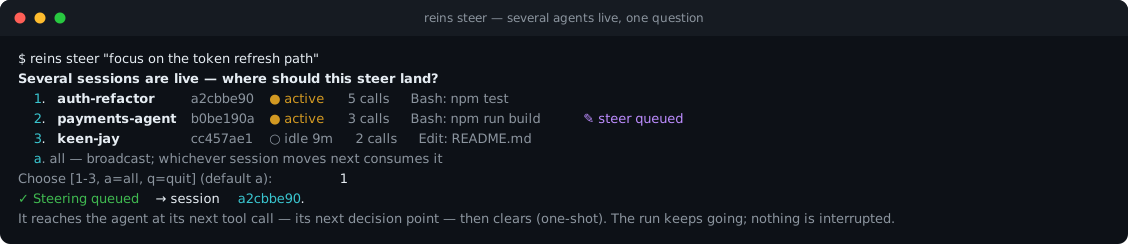
Running several agents in one repo? A plain reins steer is a broadcast — it lands on whichever session hits the next tool boundary first. When more than one session has been active in the last ~15 minutes and you're at a terminal, reins steer "<msg>" lists them and asks which one you mean (name, id, liveness, last tool call) — press Enter to keep the broadcast, pick a number to target, --broadcast to skip the question. Piped/scripted invocations are never prompted; they broadcast exactly as before.
To aim without the picker, target a session by id prefix, its auto mnemonic, or a name you gave it:
reins sessions                                   # every session has a name: rosy-egret  a2cbbe90
reins name a2cbbe90 "payments-agent"             # ...or give it your own
reins steer "stay on the payments module" --session payments-agent
A targeted nudge only reaches that session; broadcasts still go to everyone else. Names are display and addressing sugar stored in the local capture DB (so custom names need node:sqlite, Node ≥ 22.5) — the auto mnemonics are derived from the session id and work everywhere. Steering files, holds, and approvals stay keyed by the real session id; nothing control-plane ever depends on a name resolving.
Guards turn a forbidden command or path into a wall. Mechanism: PreToolUse → permissionDecision: "deny". The agent physically cannot proceed with that call — this holds even under --permission-mode bypassPermissions.
reins guard list                              # see active rules + their ids
reins guard add bash "psql.*production"       # block a command pattern (regex)
reins guard add path "infra/**"               # block writes to paths (glob)
reins guard add bash "docker .*--privileged" --reason "no privileged containers"
reins guard add bash "git push" --ask         # escalate to YOU instead of denying
reins guard add bash "npm publish" --hold     # park for your LATER approval
reins guard add tool "mcp__stripe__*" --ask   # match by tool NAME — for MCP tools bash/path can't reach
reins guard remove <id>                       # ids shown by `guard list`
reins guard reset                             # back to defaults
Rules live in .reins/policy.json (renamed from guards.json in 0.4 — old files still load forever; the first save upgrades in place, and the pre-existing guards.json is left untouched, never deleted out from under you). A rule can also carry "expires": "2026-09-01" so a temporary hold doesn't outlive its reason — an expired rule is simply inactive, not deleted. reins doctor validates the policy file: bad regex/glob, unknown type/action, duplicate ids, a malformed expires, and foot-guns like a pattern broad enough to match everything or an --ask rule in a headless setup.
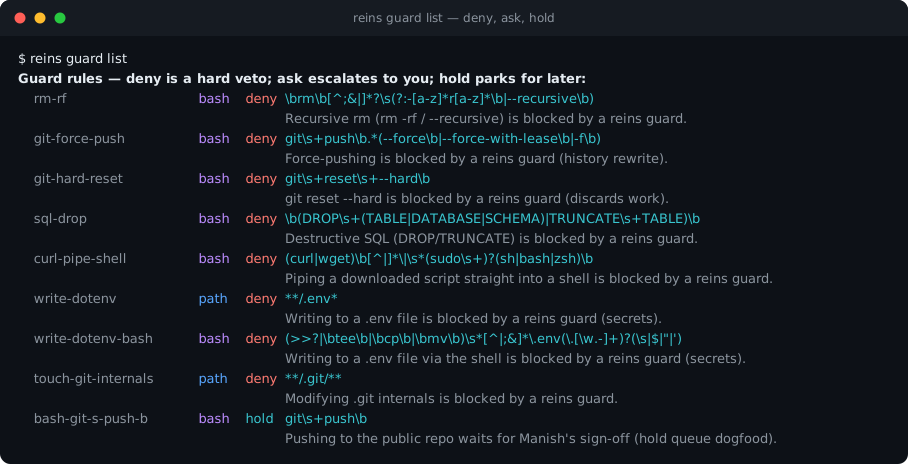
--ask is the middle hardness. Some actions aren't never — they're check with me first (pushes, prod-adjacent commands, package publishes). An ask rule doesn't veto; it makes Claude Code pause and show you the exact call with your rule's reason, and you approve or deny it in the moment (permissionDecision: "ask"). One thing to know: it needs a human at the terminal — in a headless/non-interactive run there's no one to ask, so ask effectively denies there. When you need a wall that holds unconditionally, that's deny (the default).
ask needs you at the terminal. hold is ask for the agent that runs while you sleep. A hold rule doesn't kill the attempt against a wall — it parks the proposed action and waits for you. The run survives; the action doesn't happen without you.
Since 0.4, hold has two transports, and reins picks between them for you:
- defer (preferred). In an environment Claude Code is verified to honor it — print mode,
claude -por the SDK — reins returnspermissionDecision: "defer". Claude Code parks the actual tool call inside the session itself (the turn ends withstop_reason: "tool_deferred") instead of copying it into a queue. Resuming the session (claude --resume <id> -p "continue") replays that exact call through the hook, so approving runs the original proposal — the agent never has to reconstruct it. - deny (the fallback, works everywhere). Where defer isn't honored — an interactive terminal session, or any run reins can't confirm is headless — the attempt is denied as before and the proposal is copied into
.reins/pending/. Approving lets an identical retry through; a still-running agent is steered to make it.
reins only picks defer when it can confirm the run is headless (claude -p / the SDK) — it demands positive evidence, not a guess, so anything it can't confirm (an interactive session, Windows, or just not being able to tell) falls back to deny, because a hold that silently stopped holding is worse than one that just works everywhere. Override the pick with "holdTransport": "auto" | "defer" | "deny" in .reins/config.json.
reins guard add bash "git push" --hold        # park pushes instead of denying
# ...the agent runs overnight, tries to push, gets parked, keeps working...

reins pending                                 # morning: what did they want to do?
#   ab12cd34  7h  3b9f2a1c  Bash  git push origin main  [bash-git-push]

reins approve ab12cd34                        # sign off — the agent may retry (or resume) it
reins deny ab12cd34 --steer "open a PR instead of pushing to main"
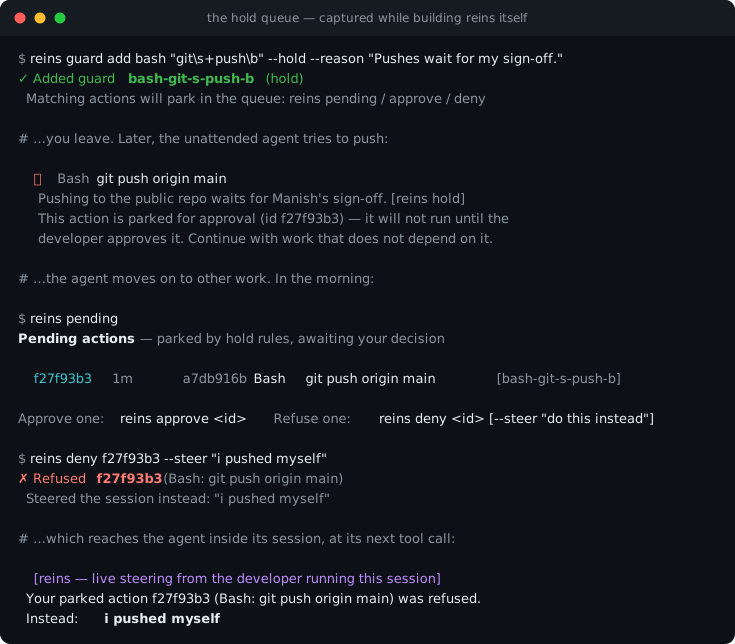
Field note — the first action ever parked by this queue was reins' own release. While building this feature we put a
--holdrule ongit pushin this very repo. An agent session finished the work, tried to push its own commits, and got parked (f27f93b3, the exchange above). The developer refused it —reins deny f27f93b3 --steer "i pushed myself"— and the refusal reached the still-running agent at its next tool call, which acknowledged and moved on. The same afternoon the rule also parked a false positive: a script whose text merely mentioned the push command. That's the "form, not intent" caveat below doing exactly what it says — both halves of the trade-off, live, on day one.
reins approve writes a one-shot decision keyed to the exact proposal — the deferred call's own id when Claude Code preserved it, otherwise this session's exact input hash — and hands you what to do next: for a still-running deny-transport hold it steers the session to retry; for a deferred hold it prints the claude --resume command, because an approval nobody resumes is the quietest possible failure. Sessions that end with parked actions say so in reins sessions / reins lastrun (⏳ awaiting approval), and the trajectory (reins audit, below) records HELD / APPROVED / REFUSED with the rule and queue ids.
The honest caveats, as always:
- Defer is print-mode only. Claude Code silently discards a deferred decision in an interactive terminal session. reins only uses defer when it can confirm the run is headless; on Windows, or whenever it can't tell, you always get the deny-and-queue fallback instead — the hold still holds, just via the mechanism that works everywhere rather than the native one.
- Defer is solo-call only. Claude Code also ignores defer when the model emitted several tool calls in one assistant message — invisible to a single
PreToolUseinvocation, so reins cannot detect it ahead of time and the held call can fall through to the normal permission flow (which may allow it under a permissive--permission-mode). Because that gap can't be closed at the boundary,PostToolUsechecks the queue from the far side instead: an action that executed while still parked is reported as a HOLD BREACH on stderr and recorded (reins audit). Detection, not prevention. Set"holdTransport": "deny"to close the gap entirely, at the cost of the native-replay UX. - Approval is exact and one-shot. By input hash for a deny-transport hold, by call id for a deferred one — either way a changed retry, even one flag, is a new proposal that parks again. And as of 0.4, a deny-transport approval is scoped to the session that proposed it: previously a one-shot allowance was globally spendable, so a second session running the identical command could consume the first's approval. Fixed.
- Only the newest deferred hold in a session survives resume. If the same session parks a second call before you get to the first, Claude Code replays only the most recent on resume — the older one won't come back.
reins pendingmarks it⏸ superseded; approving it still files the decision, but it takes effect only if the agent proposes that action again. - Same machine, same repo. The queue is files in
.reins/(pending/,decided/— renamed fromallowed/in 0.4; pre-0.4allowed/files still work, so upgrading mid-run strands nothing); there's no server, so you review from a terminal on the same checkout. (Remote/notify hook-ups are deliberately out of scope for now.) - Approval doesn't re-run anything. It permits the retry or the replay; making it happen still needs a still-running agent to act on the steer, or that session to be resumed.
- Refusals land at the boundary.
reins deny <id> [--steer "..."]files the refusal, and the agent (or the resumed session) is told the moment it comes back for that exact action — it doesn't sit re-parked, unresolved, forever. - Hold biases closed — uniquely in reins. If parking itself fails (say
.reins/is unwritable), the call is denied outright rather than allowed through. The fail-open caveat still applies one level up: a crashing hook process fails open, as everywhere.
Ships with a sane default denylist (override freely): rm -rf, git push --force, git reset --hard, DROP/TRUNCATE, curl … | sh, and writes to .env* / .git/**.
Path globs match the full path or any segment-aligned suffix, so infra/** catches the absolute file_paths Claude Code sends (e.g. /Users/you/proj/infra/main.tf) and works with Windows backslashes too.
Guards are deterministic vetoes on recognized patterns — excellent speed bumps against accidents and obvious footguns, not a sandbox. Two honest limits:
- They block a form, not an intent. Blocked from
rm -rf foo, an agent may still delete viafind -exec rm; blocked from a.envWrite it may try a shell redirect (we block the common redirect forms too, but the cat-and-mouse is unwinnable in general). For containment of a determined/adversarial agent, use OS-level sandboxing and real permission boundaries. - They match raw command text, so false positives happen.
git commit -m "removed the rm -rf call"will be blocked by therm -rfguard, because the pattern appears in the message. If a guard is too aggressive for your workflow,reins guard remove <id>it or edit.reins/guards.json— they're fully yours.
When the agent runs the same tool with identical input ≥ N times in a row (default 3), reins injects an inline warning at that tool boundary nudging it to try something else, and records the loop. Consecutive is the operative word: re-running npm test after each edit is healthy iteration and never trips the alarm — the same call three times with nothing in between does.
reins loops # list sessions where loops happenedTune the threshold in .reins/config.json ("loopThreshold").
The daily "what the hell did it just do" commands. A clean, scannable account of a run — like a git diff for agent behavior.
$ reins lastrun
reins · last run
  session  3b9f2a1c-…
  repo     /Users/you/project
  when     2026-06-18T14:22:04Z  (3m 11s)
  outcome  completed
  totals   42 tool calls · 128,540 tokens

Trajectory
  ⛔ Bash       rm -rf build/
  ✎ Write      src/auth/refresh.ts
  ✏ Edit       src/auth/index.ts
  ▶ Bash       npm test ⟳
  ▶ Bash       npm test ⟳
  ▶ Bash       npm test ⟳

Summary
  files touched  2
  commands run   8
  blocked        1 (guard vetoes)
  loops          1 (repeated ≥ 3×)
    ⟳ Bash ×3: npm test
reins sessions— list recent sessions in the project (name, status, call count, time). Handy when several agents have run in one repo. Every session gets a deterministic mnemonic (rosy-egret) derived from its id;reins name <session> "<label>"replaces it with something meaningful to you (--clearreverts). Names work anywhere a session id does:steer --session,lastrun, the steer picker.reins lastrun <session>— inspect a specific older run (id prefix or name).reins loops— just the sessions where the agent got stuck.
reins sessions is a snapshot; reins watch is the live view. A self-refreshing dashboard of every agent in the repo — each one's last tool call, whether it's active / idle / looping right now, and any steering already queued for it — built for the case a built-in queued message can't serve: aiming a nudge at one of several running agents without alt-tabbing into its window.
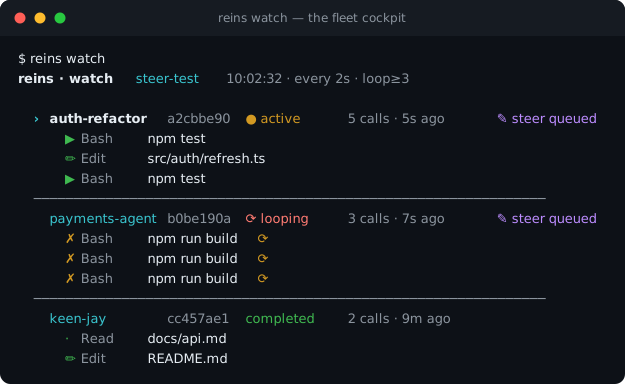
Each agent is its own block — live status (active / idle / looping / outcome), its recent trajectory tail, and any queued steering — divided from the next by a rule. Status is driven by recent tool activity, not the per-turn Stop hook, so an agent that's mid-conversation reads active, not completed.
Select a session with ↑/↓ (or j/k), then:
s— steer just that agent (writes its per-session nudge; lands at its next tool call).b— broadcast a nudge to all of them.c— clear that agent's queued steering.r— refresh now.q— quit.
Read-only over the same .reins/runs.db; it never touches a running agent except through the steering you type. Tune the cadence with reins watch -n 1 (seconds). Piped or non-interactive (reins watch --once) it prints a single snapshot instead of taking over the screen — handy in scripts. No TUI library, no daemon — just ANSI on the terminal you already have.
watch is the live view; reins report is the browsable archive. It reads .reins/runs.db and writes a single self-contained HTML file (inline CSS, no JS framework, zero network requests — nothing leaves your machine) with:
- Summary cards — sessions, tool calls, blocked, failed, loops, plus token and cost rollups when the transcript had them (best-effort; hidden when never captured).
- Per-tool breakdown — how the calls split across tools (Bash vs Edit vs Read…), with per-tool blocked/failed counts.
- Guard-fire heatmap — which guard rules actually fired, split into denied (⛔) vs escalated-to-you (✋), so you can see which rules earn their keep and which never trigger.
- Every session's full trajectory — guard-blocks (⛔ with the rule id that fired), escalations (✋), failures (✗), and loops (⟳) marked inline.
reins report            # writes .reins/report.html
reins report --open     # ...and opens it in your browser
reins report -o /tmp/run.html   # custom path (e.g. to share a single run)
It's the same local-first deal as the rest of reins: a file you own, readable offline, safe to delete. The richer "what happened across every run" view a terminal can't give you.
It's all in .reins/runs.db — three tables (sessions, tool_calls, outcomes) you can query with raw SQL whenever you want. Token/cost columns are best-effort (read from the session transcript) and may be null; that's harmless.
-- which runs ended after a guard block?
SELECT s.id, s.final_outcome, COUNT(*) AS blocked
FROM tool_calls t JOIN sessions s ON s.id = t.session_id
WHERE t.input_summary LIKE 'DENIED:%'
GROUP BY s.id;
Don't want any log at all? Set REINS_NO_SQLITE=1 — capture is fully disabled and steering/guards keep working.
The hooks read the Claude Code event JSON on stdin and reply on stdout — you can exercise them by hand. (expand)
Useful for trying out a guard or steering rule without a live run:
# Will this command be blocked?
echo '{"tool_name":"Bash","tool_input":{"command":"rm -rf build"}}' | reins hook pre-tool
# -> {"hookSpecificOutput":{"hookEventName":"PreToolUse","permissionDecision":"deny",...}}

# Does my queued steering inject?
reins steer "keep it minimal"
echo '{"tool_name":"Bash","tool_input":{"command":"ls"}}' | reins hook pre-tool
# -> {"hookSpecificOutput":{"hookEventName":"PreToolUse","additionalContext":"[reins …]"}}

# Record a tool call (capture + loop detection):
echo '{"session_id":"demo","tool_name":"Bash","tool_input":{"command":"npm test"},"tool_response":{}}' | reins hook post-tool
Useful fields per event: session_id, cwd, tool_name, tool_input (pre/post); tool_response (post); transcript_path, reason (stop). No output from a hook = "allow, inject nothing."
Two notes for manual testing: events without a session_id don't get recorded (so quick guard/steer checks won't litter your trajectory log); and a session you record by hand will show as "still running" in reins lastrun until you also send a stop event for it.
| Steering & Guards | Capture (lastrun/loops/sessions) |
|
|---|---|---|
| Node ≥ 22.5 | ✅ | ✅ via built-in node:sqlite |
| Node 18–22.4 | ✅ | ✅ if you npm i -g better-sqlite3, else disabled |
REINS_NO_SQLITE=1 |
✅ | off by choice |
The live reflexes never touch the database, so they work on any Node ≥ 18. Capture needs a synchronous SQLite backend: node:sqlite (built in on 22.5+) or the optional better-sqlite3. If neither is present, capture degrades silently — your agent is never affected — and reins doctor / reins lastrun tell you why. (Windows, macOS, Linux all supported; path guards normalize separators.)
reins makes zero network calls. No telemetry, no phoning home, no account, ever. Your trajectories live in a SQLite file on your disk that you can read, query, back up, or delete. That privacy — and the raw-SQL hackability — is the entire point.
.reins/steering.txt is security-sensitive: write access to it equals steering access. Anything that can write that file can inject context into your running agent at its next tool call. reins creates .reins/ as 0700 (owner-only) and git-ignores it, but be deliberate:
- Do not let an untrusted or automated writer feed it. A CI job, a shared script, or any process you don't fully control writing to
.reins/steering.txtis a hijack path into your agent. Treat write access to that file as you'd treat write access to your prompts. - Steering is a soft channel — the model still weighs it and resists outright contradictions — so this is defense-in-depth, not a sole control. v1 ships no signing on the steering file; the mitigations are filesystem permissions (
0700) and not pointing untrusted writers at it. .reins/decided/(.reins/allowed/before 0.4, still read) is approval access. One-shot hold decisions — approvals and refusals — are files there; anything that can write them can pre-approve (or fake-refuse) a parked action. Same posture, same mitigations.
Guards, separately, are not a containment boundary (see What guards are — and are not).
A crashing hook fails open (the agent proceeds) so a bug in reins can never wedge your agent — which also means guards are best-effort if the hook itself errors.
reins init [--print|--local]     Set up .reins/ and wire (or print) the hooks
reins uninstall [--purge]        Remove the hooks (--purge also drops .reins/)
reins doctor                     Diagnose your setup
reins steer "<msg>" [--replace]  Queue steering for the next tool call (appends;
                                 several live agents + a TTY → a picker asks which)
reins steer "<msg>" --session <id|name>   Target one agent (id/prefix/name/mnemonic)
reins steer "<msg>" --broadcast  Skip the picker; whichever agent moves next gets it
reins steer [--clear]            Show / clear pending steering
reins name <session> "<label>"   Name a session; --clear reverts to the auto mnemonic
reins guard list|add|remove|reset    (add takes --ask to escalate, --hold to park)
reins pending                    List actions parked by hold rules
reins approve <id>               Approve a parked action (one-shot, exact call)
reins deny <id> [--steer "..."]  Refuse a parked action, optionally steer instead
reins audit [session] [--json]   Every gate decision (deny/ask/hold/allow/breach)
reins lastrun [session]          Readable account of a run (id prefix or name)
reins sessions [-n N]            List recent sessions (with names)
reins watch [-n SECS] [--once]   Live cockpit: all agents, steer any one
reins report [--open] [-o FILE]  Self-contained local HTML report of all runs
reins loops                      Sessions where the agent looped
reins hook pre-tool|post-tool|stop   (invoked by Claude Code, not you)
Each hook is reins hook <pre-tool|post-tool|stop>, reading the event JSON on stdin and replying over stdout per the Claude Code hook contract. pre-tool checks guards (deny, ask, or hold — parked via defer where Claude Code honors it, else deny-and-queue) then steering (inject + clear). post-tool records the call, raises the loop alarm on consecutive repeats, and flags a HOLD BREACH if a still-parked action executed anyway. stop delivers any still-pending steering (briefly holding the stop), then finalizes the run — noting any actions still parked. State lives in .reins/: steering.txt, policy.json (guards.json before 0.4, still read), pending/, decided/ (allowed/ before 0.4, still read), config.json, runs.db. CLI commands find .reins/ by walking up from your current directory, so they work from any subdirectory of the project.
The file formats and decision semantics behind guards/steering/holds are written up separately, vendor-neutral, in SPEC.md — not a standard, just a description of what reins does, in case another harness ever wants the same gate.
See CONTRIBUTING.md. Keep it small and sharp.
MIT · no daemon, no backend, no account — just hooks, and files you own
If reins caught something dumb before it happened, consider a ⭐