
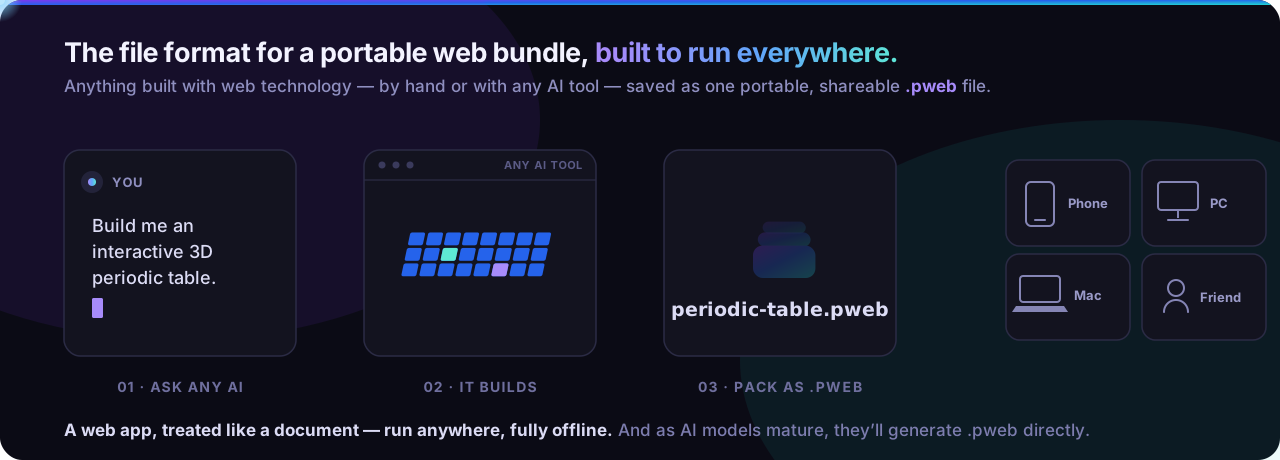
The file format for a portable web bundle, built to run everywhere. One .pweb file that runs on any device, fully offline — no server, no web origin, no app store.
PortableWeb is not an AI platform. It’s the open format for what you — and any AI tool — build with web technology.


AI-assisted tools have changed the economics of building interactive web content: a simulation, a small game, a 3D experience, or a data-rich report that used to take days of skilled work now takes minutes — and it’s being made by the million, with whichever tools people already use. None of it has a natural place to live.
Every existing option forces an unacceptable tradeoff:
| Option | The catch |
|---|---|
| Deploy to a server | Needs hosting and a live connection. Wrong tool for ephemeral or personal content — and it vanishes when the host goes dark. |
| Publish to an app store | Developer accounts, review cycles, maintenance. Absurd for the volume of artifacts being made today. |
| Portable and archival, but it flattens everything. A game loop or live simulation can't survive the trip. | |
| EPUB | Its scripting enhances a reading experience; it can't represent a game or a real-time simulation. |
| Web Bundles | A network transport optimization, never broadly implemented. No offline-first execution model. |
| Web App Manifest | Describes an already-deployed app. Tied to a web origin — it says nothing about content with no server at all. |
No existing format treats interactive web content as a portable, self-contained, immediately runnable unit.
A PortableWeb bundle (.pweb) packages the HTML, CSS, JavaScript, and media of an interactive experience into one file. A compatible viewer opens it in its own sandboxed window — on desktop, mobile, or anywhere — entirely offline, with no deployment, no web origin, and no browser required.
It behaves like a document: save it, copy it, email it, archive it, or AirDrop it across the room. It works the first time and the thousandth, and it doesn't expire when a CDN goes dark. The format is content-model agnostic — a bundle can hold a game, a presentation, a simulation, a 3D experience, a scientific model, a report, or a book.
And the loop closes. Today you ask a model to build something, then pack the result as a .pweb. As models mature, they'll emit the .pweb directly — the finished, portable file, instantly usable everywhere.
A .pweb is just a ZIP. Rename it to .zip and unpack it with anything — no proprietary container, no DRM, no hidden state.
my-document.pweb
├── mimetype          # required · first entry, uncompressed (application/vnd.portableweb+zip)
├── manifest.json     # required · id, version, title, entry point, declared permissions
├── index.html        # required · the entry the viewer loads first
├── assets/  media/   # images, fonts, audio, video
└── scripts/ styles/  # JS modules and stylesheets
| Self-contained | A bundle carries everything it needs. No CDN dependency, no broken script tags in five years. |
| Sandboxed | No filesystem access, network off by default, storage scoped per bundle. Permissions declared in the manifest, enforced by the viewer, deny-by-default. |
| Archival | Each spec version freezes a stable feature subset. A v1.0 bundle renders identically in any v1.0 viewer, indefinitely. |
| Owned | A bundle is a file. No host, no account, no platform. It belongs to whoever holds it. |
PortableWeb isn't a private format. It's being developed where the web is built:
- 🌐 W3C Community Group — the Portable Web Content Format CG. Container, manifest, viewer conformance, per-bundle storage, and a genuinely new permission-gated offline peer-to-peer channel (Bluetooth / Wi-Fi Direct) for multiplayer and collaboration without any server. Anyone may join; W3C membership not required.
- 📜 IETF Internet-Draft —
draft-selvaraj-portableweb-formatdefines the container, manifest schema, security considerations, and theapplication/vnd.portableweb+zipmedia type.
The PortableWeb web app runs entirely in your browser — open and render any .pweb, pack a project folder into a bundle, validate one against the spec, or scaffold a new project. No install, no account, nothing leaves your device.
PortableWeb is a small project with large ambitions. The format is still in draft, which means early feedback shapes it most.
- 🌐 Join the W3C Community Group — help shape the spec where it's being standardized.
- 📖 Read & comment on the spec — open issues or PRs on
portableweb/spec. - 🧪 Build something — make a
.pweband share it. Real-world usage drives the spec far more than theory. - 🛠️ Contribute code — the CLI, viewer, and website all welcome PRs.
- 📣 Spread the word — tell anyone who works with documents, archival, AI-generated content, or interactive media.
