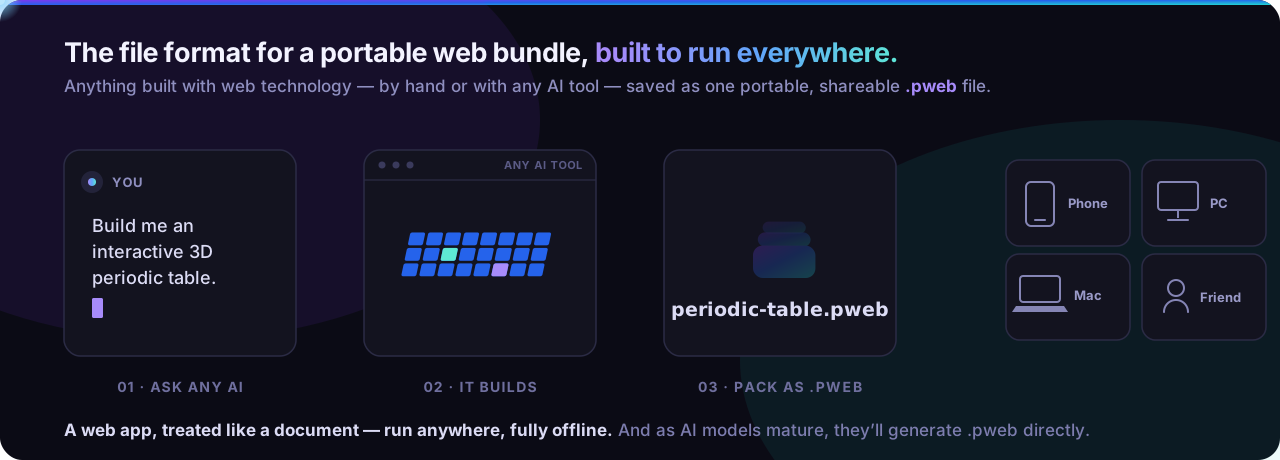
The format spec for .pweb: one self-contained file for interactive content built with web technology — runs on any device, fully offline.
This repository holds the specification, reference examples, and the IETF draft source. For the project's story and the web app, visit portableweb.org.


A PortableWeb bundle (.pweb) packages the HTML, CSS, JavaScript, and media of an interactive experience into one file. A compatible viewer opens it in its own sandboxed window — on desktop, mobile, or anywhere — entirely offline, with no deployment, no Web origin, and no browser required.
It behaves like a document: save it, copy it, email it, archive it. The format is content-model agnostic — a bundle can hold a game, a presentation, a simulation, a 3D experience, a scientific model, a report, or a book.
Looking for the normative text? It lives in
ietf/and is published as an IETF Internet-Draft: draft-selvaraj-portableweb-format. This README is a map, not the spec itself.
| File extension | .pweb |
| Media type | application/vnd.portableweb+zip |
| Container | ZIP (with a mimetype entry as the first, uncompressed file — as in EPUB) |
| Required inside | mimetype, manifest.json, and an HTML entry file |
| Default permissions | Deny-by-default (only scoped storage and fullscreen on) |
| Identifiable | From the first ~80 bytes, without unpacking |
.
├── spec/         The specification documents — start here
│   ├── README.md     Index + roadmap of all spec documents
│   ├── CONTAINER.md  The file format: ZIP layout, mimetype, required entries
│   └── MANIFEST.md   The manifest.json schema: required & optional fields
├── ietf/         The IETF Internet-Draft source (kramdown-rfc)
├── examples/     Runnable reference bundles
│   ├── hello.pweb        The simplest valid bundle
│   └── hello-source/     Its unpacked source, ready to rebuild
├── scripts/
│   └── build-pweb.sh     Packs a folder into a spec-correct .pweb
└── LICENSE       MIT (covers the tooling/code in this repo)
- Read the spec —
spec/CONTAINER.mdfor the file format, thenspec/MANIFEST.mdfor the manifest schema. Thespec/README.mdindex lists everything, including the planned companion specs. - Inspect a real bundle — a
.pwebis just a ZIP:unzip -lv examples/hello.pweb # list contents unzip -p examples/hello.pweb manifest.json # read one file
- Preview it (bypasses the viewer sandbox — preview only):
unzip examples/hello.pweb -d /tmp/hello && open /tmp/hello/index.html - Build your own from a folder:
The script enforces the correct ZIP layout (mimetype first, uncompressed, no extra fields).
scripts/build-pweb.sh examples/hello-source my-bundle.pweb
| Document | Status | Description |
|---|---|---|
| CONTAINER.md | Draft 0.1 | The file format: ZIP layout, mimetype, required entries. |
| MANIFEST.md | Draft 0.1 | The manifest.json schema: required and optional fields. |
SANDBOX.md |
Planned | The runtime sandbox and permission-enforcement model. |
RUNTIME-PROFILE.md |
Planned | The frozen subset of HTML/CSS/JS allowed per spec version. |
STORAGE.md |
Planned | Storage isolation, quotas, export/import, snapshot bundles. |
SIGNING.md |
Planned | Optional cryptographic signing of bundles. |
COMMS.md |
Planned | Inter-bundle communication over local channels (peers). |
⚠️ Pre-release. This is v0.1 (draft) — the container and manifest only. Breaking changes may occur until v1.0.
- v0.1 — Container and manifest (this release)
- v0.2 — Add
SANDBOXandRUNTIME-PROFILE; first viewer reference implementation - v0.3 – v0.9 — Iterate on real-world usage; gather feedback from early adopters
- v1.0 — Stable spec. From v1.0 onward, every bundle stays renderable forever; new features ship in v1.x / v2.x without breaking v1.0 bundles.
- 🌐 W3C Community Group — Portable Web Content Format CG. Container, manifest, viewer conformance, storage, and a permission-gated offline peer-to-peer channel. Anyone may join; W3C membership is not required.
- 📜 IETF Internet-Draft —
draft-selvaraj-portableweb-formatdefines the container, manifest schema, security considerations, and theapplication/vnd.portableweb+zipmedia type.
The format is still in draft, which is exactly when feedback shapes it most.
- 🐛 Open an issue — questions, ambiguities, and proposals are all welcome.
- 🔧 Send a PR — corrections and clarifications to the spec, new examples, or tooling.
- 🧪 Build a
.pweband share it — real-world usage drives the spec far more than theory. If you make something interesting, add it toexamples/via PR. - 🌐 Join the W3C CG to help standardize it.